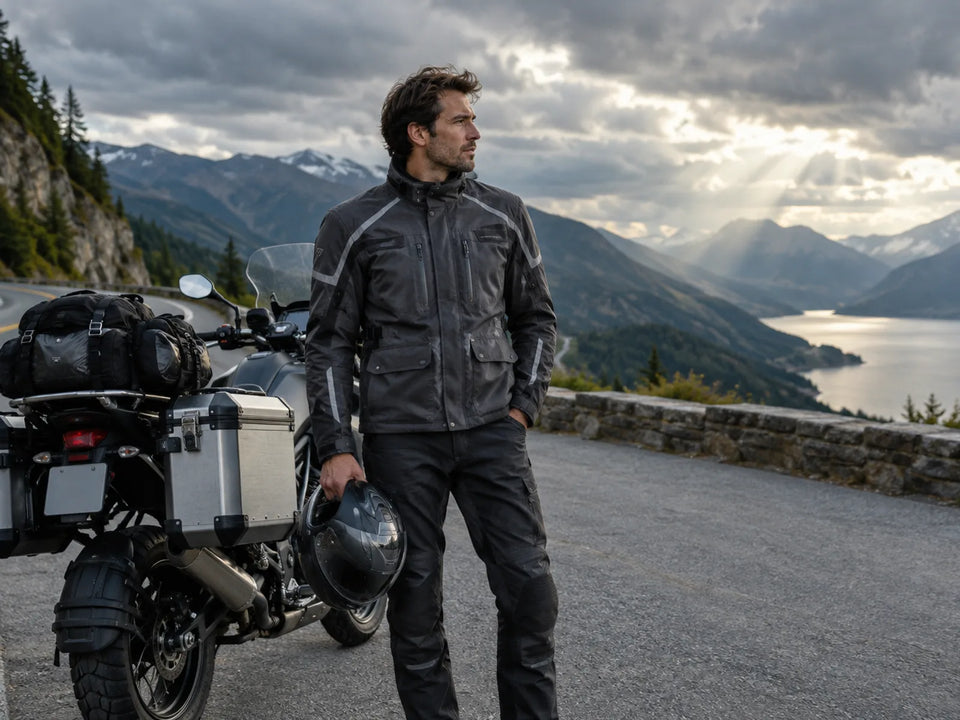

A good touring motorcycle jacket is a textile jacket built for a full day in changing weather: a laminated or drop-liner waterproof layer, a zip-out thermal liner, vents that still work with the liners in, waterproof pockets you reach at fuel stops, and waist and arm adjusters that hold the armor in place for hours.
A 400-mile day at 70 mph is close to six hours of riding before stops, which is why touring jackets rank comfort and adjustment above looks. Waterproof chest and inner pockets matter more than pocket count, and zip-out thermal and waterproof liners let one shell cover a cold start and an afternoon shower. A laminated membrane keeps the outer fabric from soaking through, while a drop liner costs less and comes out in heat. A 2004 Auckland study in the BMJ linked reflective or fluorescent clothing to a 37% lower risk of crash-related injury.
What makes a jacket good for touring?
A jacket is good for touring when it stays protective and comfortable for a full day of riding while the weather changes around you, and a touring jacket manages that with layers and adjusters instead of a single fabric. A 400-mile day at 70 mph adds up to about 5.7 hours of riding before fuel, food and photo stops.
That much saddle time changes what counts. A collar that rubs a little in the store rubs for hours on the road. Armor that slips off your elbow at the first stop stays off it for the rest of the day, and a pocket you can't open with gloves on stays closed.
Touring jackets handle the long day with five systems: a weatherproof shell, removable liners, vents, pockets and adjusters at the waist, arms and collar. Judge each one by how it works in hour five, not in the first five minutes.
Which pockets matter on a touring jacket?
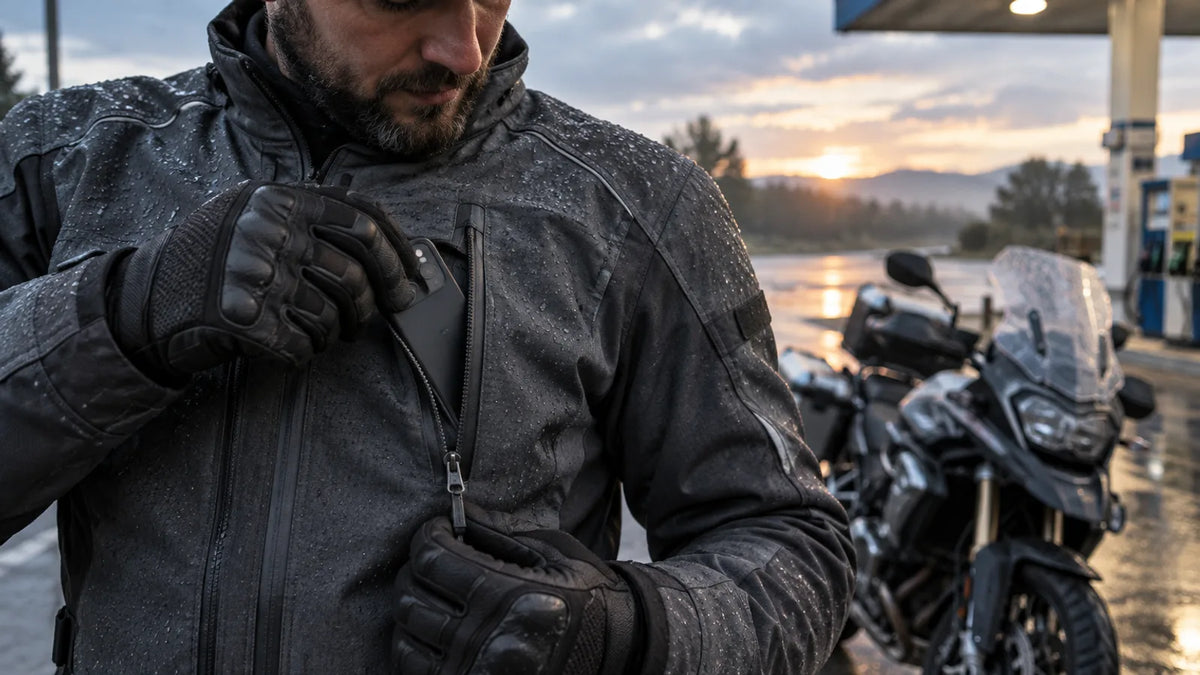
The pockets that matter on a touring jacket are the waterproof ones and the ones you reach with gloves on, because a long day means opening them at every fuel stop and keeping a phone and wallet dry through rain. The touring jacket pockets below run in order of importance.
- A waterproof chest pocket on a touring jacket keeps your phone dry and reachable at a fuel stop without opening the main zip. REV'IT's Potential GTX, for example, has a waterproof slit pocket on the chest.
- Waterproof inner pockets on a touring jacket keep your wallet, license and registration dry behind the front closure, and the Potential GTX has two.
- Outer hand pockets on a touring jacket hold gloves, earplugs and a toll card, but on a drop-liner jacket they sit outside the waterproof layer, so treat them as wet pockets in rain.
- A rear cargo pocket on a touring jacket, found on some models, carries a thin layer or spare gloves you won't need until the next stop.
- A pocket inside the thermal liner of a touring jacket leaves with the liner when it zips out, so don't keep keys there. REV'IT's Potential GTX has one.
Placement beats count. A few waterproof pockets you can reach are worth more than a long list of pockets you can't.
How do removable liners work on a touring jacket?
Removable liners zip or snap inside a touring jacket's shell as separate layers: a quilted thermal liner for warmth and, on drop-liner jackets, a waterproof membrane liner that sits between the shell and the thermal layer. You add or remove them as the day cools or warms.
REV'IT and Scott Sports both describe GORE-TEX's Z-liner construction this way, with the membrane hung between the outer shell and the lining. Adventure Bike Rider magazine's 2021 guide to laminated jackets calls the layout a three-layer jacket.
The liner system has three touring-specific costs. A thermal liner pulled out on a hot afternoon needs room in your luggage, so check how small it packs. A removable waterproof liner has to be carried and refitted at the roadside when rain threatens, which Adventure Bike Rider calls awkward. And the middle waterproof layer blocks some of the airflow from the vents, so a three-layer jacket vents less well with it fitted.
How do touring jackets handle rain?
Touring jackets keep rain out with a waterproof, breathable membrane that is either laminated to the inside of the outer shell or hung as a separate drop liner behind it. A laminated jacket has its membrane bonded to the shell fabric, so there's no loose waterproof layer at all.
MCN's laminated jacket buying guide says the bonded membrane, applied with heat and pressure, keeps the jacket from getting waterlogged, but it costs more and doesn't breathe as well as a non-laminated fabric. A drop liner costs less and comes out on hot days, but in steady rain the outer shell soaks up water and, per Adventure Bike Rider, gets heavy and cold.
Pick laminated for regular rain riding, such as an October tour of the Pacific Northwest. Pick a drop liner for dry-climate touring, where the waterproof layer stays in the saddlebag most days.
How do touring jacket features compare by priority?
Touring jacket features rank by how often they matter on a 400-mile day: armor fit, collar and cuffs matter every mile, pockets at every stop, and weather layers only when the weather turns. The table weights each touring jacket feature by that frequency.
| Feature | When it matters on a 400-mile day | What to look for | Priority |
|---|---|---|---|
| Armor fit and adjusters | Every mile | Waist and arm adjusters that hold shoulder and elbow armor on the joints while seated | Essential |
| Collar and cuffs | Every mile | A collar that closes without rubbing; cuffs that seal around your gloves | Essential |
| Waterproof layer | Every hour of rain | A laminated membrane, or a drop liner you can fit at the roadside | Essential in wet regions, high elsewhere |
| Waterproof pockets | Every fuel stop | A waterproof chest pocket and inner pockets you reach with gloves on | High |
| Vents | Warm afternoons and slow traffic | Chest intake and back exhaust vents that open with gloves on | High |
| Thermal liner | Cold mornings and mountain passes | A zip-out liner that packs small | High in spring and fall |
| Reflective panels | Dusk, night and rain | Reflective material on the back, arms and chest | High for evening riding |
| Pants connection zip | In a slide | A zip that matches your riding pants | Medium |
| Weight | Every mile, more when wet | A shell that holds little water and a weight you stop noticing after the first hour | Medium |
Armor fit tops the list because armor protects only while it's on the joint. A jacket that wins on pockets and loses on armor fit is the wrong touring jacket.
How heavy should a touring jacket be?
A touring jacket should be as light as its protection allows, and no standard sets a target weight, so judge weight only after the EN 17092 class and armor check out. EN 17092 is the European standard for motorcycle protective garments.
Makers rarely help here. Neither Dainese's Super Rider 2 Absoluteshell page nor REV'IT's Potential GTX page lists a weight, so a bathroom scale is often the only number you'll get.
Weight comes from four places: the shell fabric, the armor, the liners and the water the shell holds. Water is the one that changes during the day, because a drop-liner jacket's outer shell soaks up rain while a laminated shell holds less. Liners weigh something only while they're in. Armor is the part not to trade away for a lighter jacket, and our jacket armor pocket guide shows what yours holds.
Wear the jacket at home for 30 minutes with the liners in and your arms forward as if on the bars. A jacket that drags at your shoulders by then feels heavier still by the afternoon of a long day.
Do touring jackets need hi-vis panels?
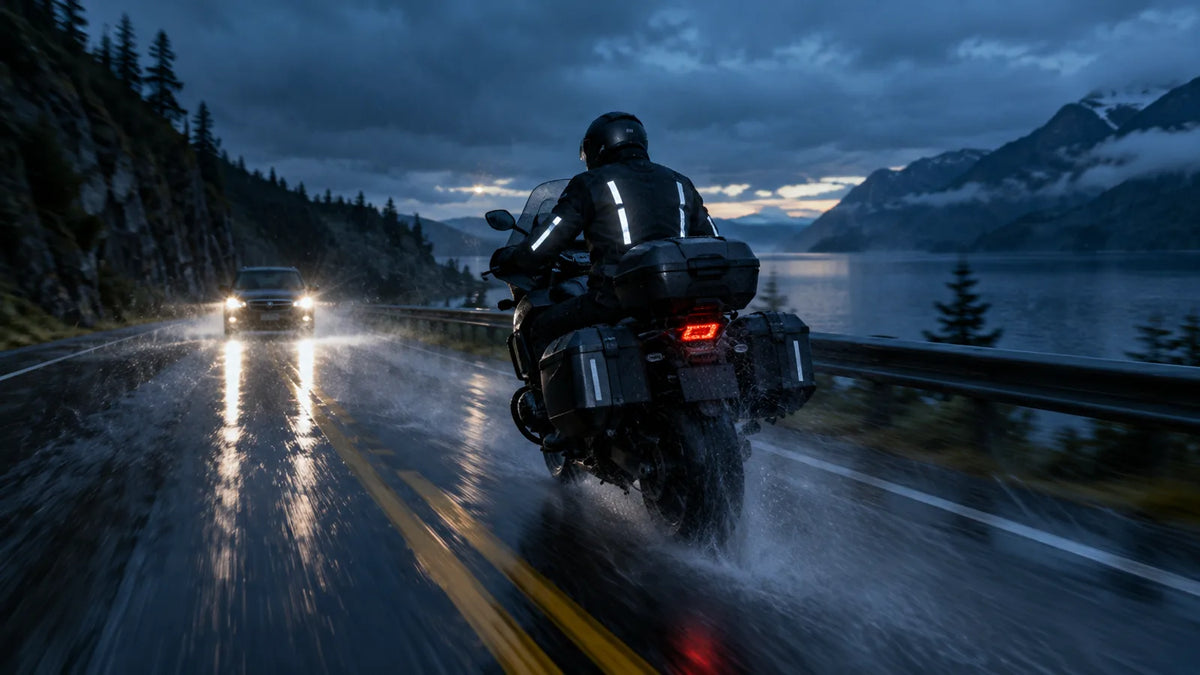
Yes, reflective or fluorescent panels earn their place on a touring jacket, because long days often end at dusk or in rain. A 2004 case-control study of riders in Auckland, New Zealand, by Wells and colleagues in the BMJ found that wearing any reflective or fluorescent clothing was linked to a 37% lower risk of crash-related injury, an association rather than proof. Look for reflective material on the back, arms and chest.
Can a touring jacket work for commuting?
Yes, a touring jacket works well for commuting, since the same waterproof layer, pockets and reflective panels handle a wet ride to work. The trade-offs are bulk at the office and heat in stop-and-go summer traffic, where mesh motorcycle jackets move more air.
Where can you find touring motorcycle jackets?
AtomBiker, a US online store for motorcycle helmets, jackets, gloves, boots and pants, carries all-season textile riding jackets and a women's touring jacket in its motorcycle jackets collection. Product pages list different details, so check each one for a named waterproof membrane, the armor standard and the liner type before you buy.
Frequently asked questions
Should you size a touring jacket with the liners in?
Yes, size a touring jacket with every liner fitted, because the thermal and waterproof layers take up room that a T-shirt fitting hides. Measure your chest over your heaviest base layer, size up if you'll add a back protector, and check the seated fit with the liners in, as our guide on how tight a motorcycle jacket should be describes.
Is a leather jacket good for touring?
Yes, a leather jacket works for touring in dry, mild weather, and leather touring jackets such as Fox Creek's Classic Motorcycle Jacket II add vents and a zip-out insulated liner. Rain is the weak point, since few leather jackets are waterproof, and our guide to leather vs textile motorcycle jackets compares the two for year-round riding.
Is a touring jacket too hot for summer?
No, a touring jacket with its liners out and vents open handles warm days, though Adventure Bike Rider notes that a laminated shell gets stuffy in warm weather. In Phoenix or Las Vegas heat, a dedicated summer jacket does better than any touring shell.
Should a touring jacket zip to your riding pants?
Yes, a jacket-to-pants zip keeps a touring jacket from riding up and exposing your lower back in a slide. Connecting zips usually fit only pants from the same brand, so buy the jacket and pants as a pair if you want one. REV'IT's Potential GTX, for example, has a short connection zipper for its riding pants.
Is a touring jacket the same as an adventure jacket?
No, a touring jacket is built mainly for highway comfort and weather, while an adventure jacket adds more venting and room for standing on the pegs off-road. Some brands use both labels for one jacket, and our guide to motorcycle jacket types shows where each style fits.
Shop this guide
Start with the right questions.
Compare construction, fit and features. Open each product for its available sizes, current price and stated certifications.