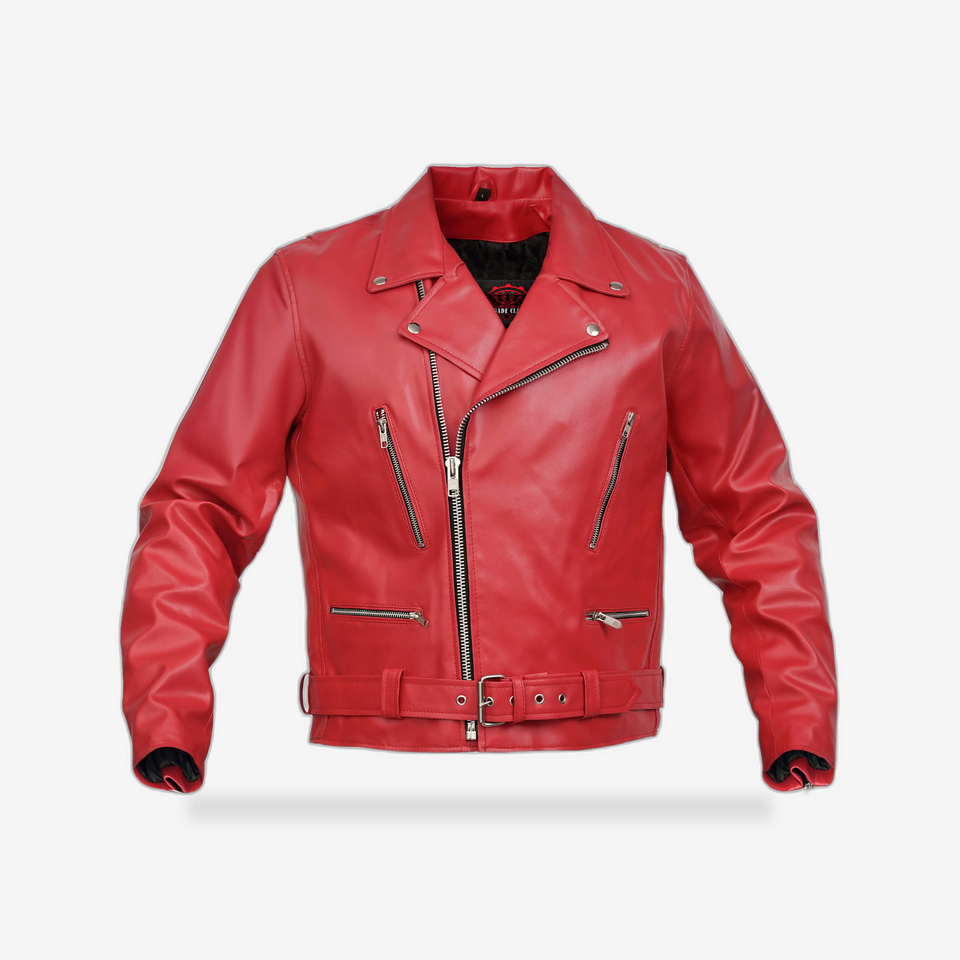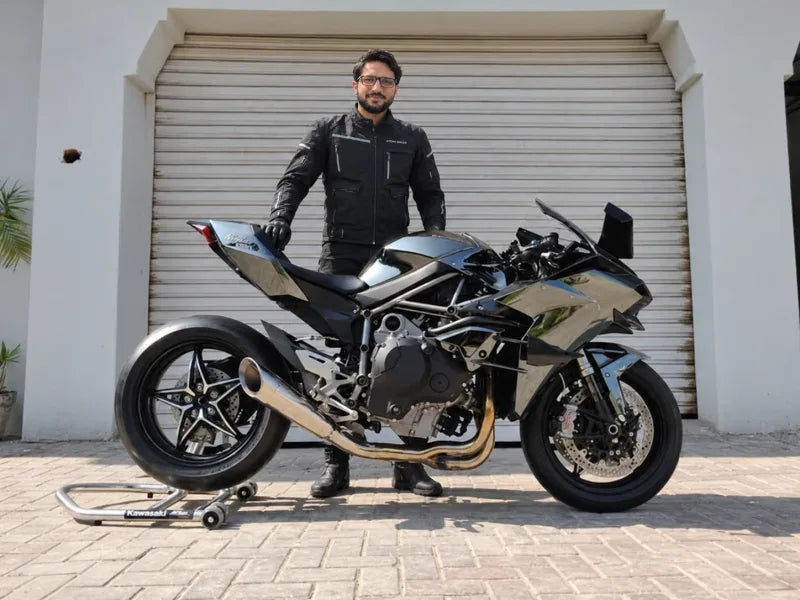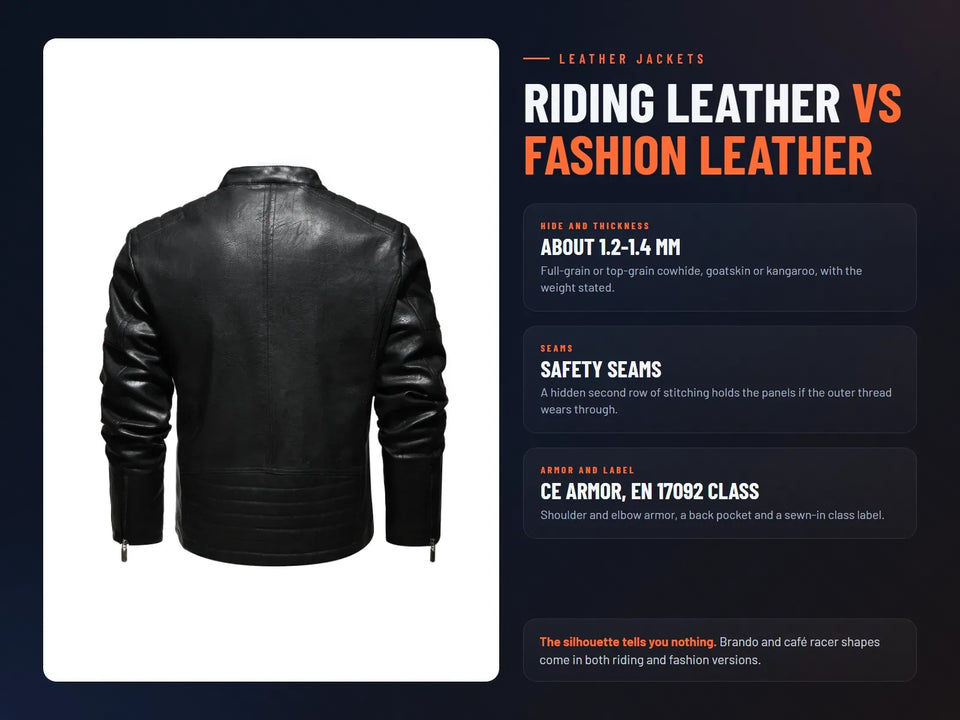

A leather motorcycle jacket is crash-worthy when its hide, stitching, armor and cut are built for a slide: full-grain or top-grain cowhide, goatskin or kangaroo about 1.2-1.4 mm thick, safety seams, CE shoulder and elbow armor with a back pocket, and a cut that stays put while you reach for the bars. Fashion leather skips most of these.
Fashion jackets are cut to look right standing up, use lighter leather and carry no armor or seam test. Riding makers publish the hide weight, such as 1.2 mm cowhide on Dainese's Racing 5 and 1.4 mm on Vanson's competition leather. A burst seam opens a jacket even when the hide survives, which is why EN 17092, the European standard for motorcycle garments, tests seams as well as abrasion. In a store, a seam pull, a look inside the armor pockets and a seated reach test sort one from the other in minutes.
What makes a leather jacket crash-worthy?
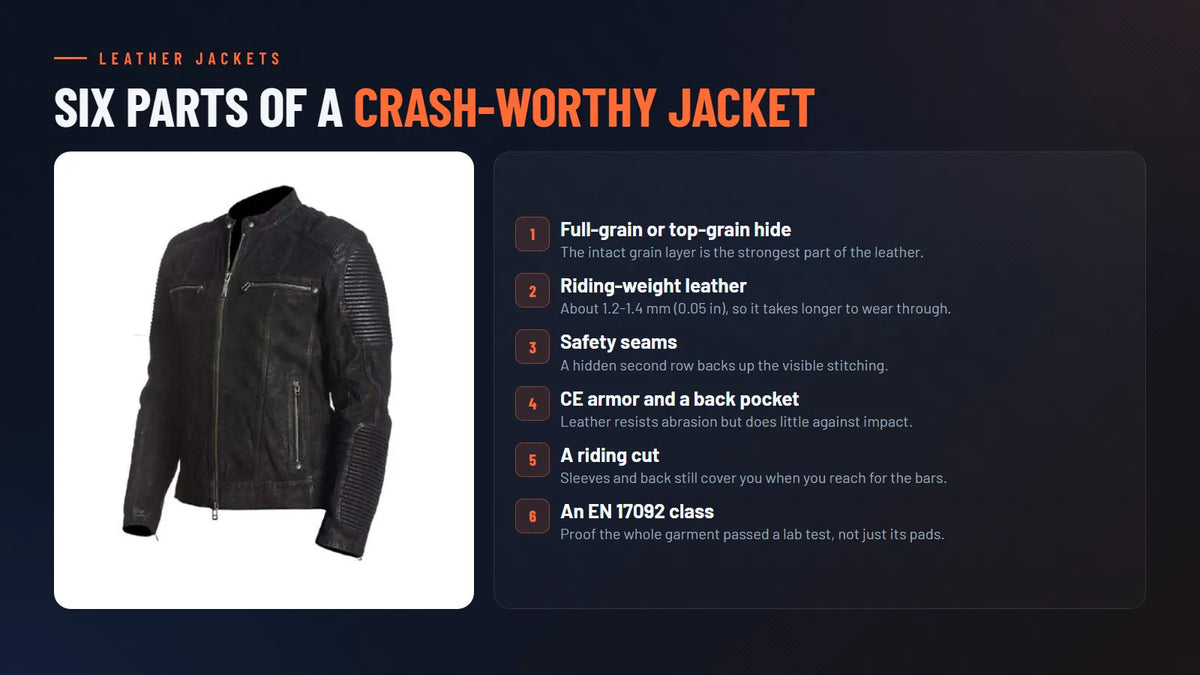
A leather jacket is crash-worthy when six parts hold up together in a slide: the hide, its thickness, the seams, the armor, the cut and a tested garment class. Miss one, and the jacket has a weak spot the other five can't cover.
Each crash-worthy feature below is listed with the job it does in a crash.
- A crash-worthy leather jacket uses full-grain or top-grain hide, because the intact grain layer is the strongest part of the leather.
- A crash-worthy leather jacket uses riding-weight leather, about 1.2-1.4 mm (0.05 in) thick, so the hide takes longer to wear through on pavement.
- A crash-worthy leather jacket joins its panels with safety seams, which back up the visible row of stitching with a hidden one.
- A crash-worthy leather jacket carries CE-marked armor at the shoulders and elbows plus a pocket for a back protector, because leather resists abrasion but does little against impact.
- A crash-worthy leather jacket is cut for the riding position, so the sleeves and back still cover your wrists and lower back when you reach for the bars.
- A crash-worthy leather jacket names an EN 17092 class on a sewn-in label, the proof that the finished garment passed a lab test and not just its pads.
How is riding leather different from fashion leather?
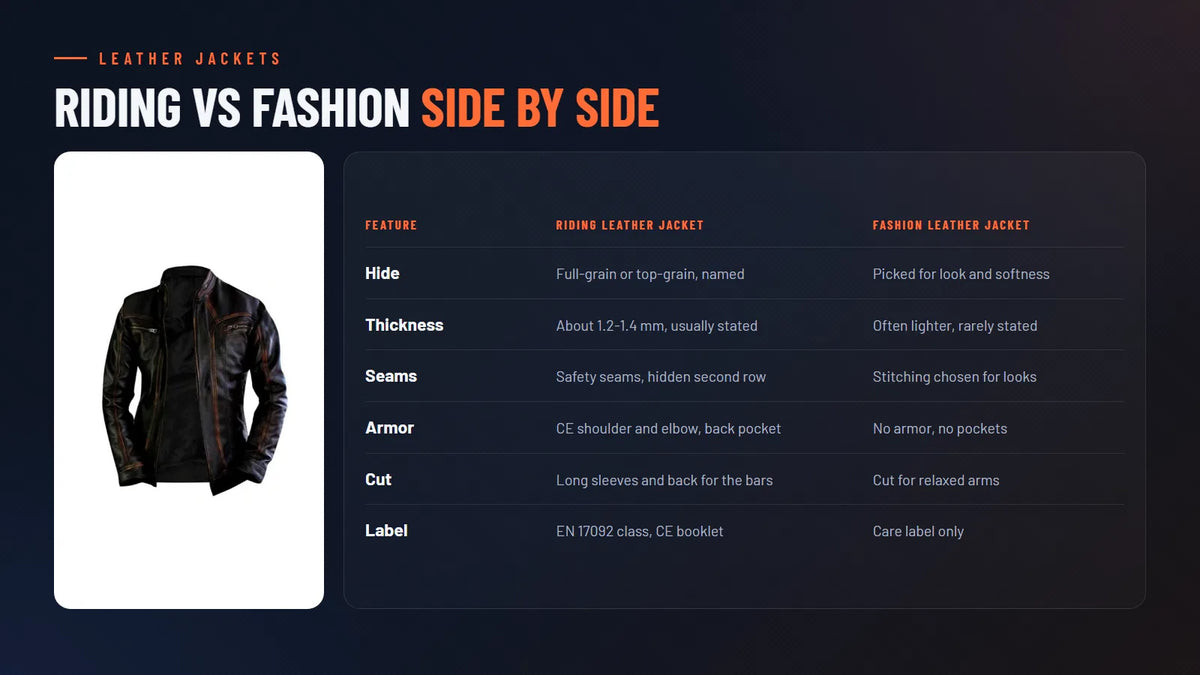
Riding leather differs from fashion leather in what it's built to survive: a riding jacket is made to stay in one piece on the road, and a fashion jacket is made to look and feel good off the bike. The silhouette tells you nothing, since a Brando or café racer shape comes in both.
The table compares a typical riding leather jacket with a typical fashion leather jacket on the points you can see or read.
| Feature | Riding leather jacket | Fashion leather jacket |
|---|---|---|
| Hide | Full-grain or top-grain cowhide, goatskin or kangaroo | Any hide, picked for look and softness |
| Thickness | About 1.2-1.4 mm (0.05 in), usually stated | Often lighter, rarely stated |
| Seams | Safety seams with a hidden second row | Stitching chosen for looks, never tested |
| Armor | CE shoulder and elbow armor, back protector pocket | No armor and no pockets |
| Cut | Sleeves and back cut long for reaching the bars | Sleeves cut to look right with arms relaxed |
| Label | EN 17092 class on a sewn-in label, plus a CE user booklet | Care label only |
Return of the Cafe Racers made the same cut point in its 2018 buying guide: fashion sleeves are shaped for relaxed arms, so they pull back off your wrists in the riding position, and a fashion back leaves your spine and kidneys exposed when you lean forward.
How thick should motorcycle jacket leather be?
Motorcycle jacket leather should be about 1.2-1.4 mm (0.05 in) thick, the hide weight riding-gear makers list for street and track jackets. Dainese lists 1.2 mm Tutu cowhide on its Racing 5 jacket, and Vanson rates its competition-weight cowhide at 1.4 mm.
Lighter leather sits below that range. Riding-gear retailer Eagle Leather puts a typical lightweight leather jacket at about 1 mm, a general-purpose riding jacket at 1.2 mm and racing hides at about 1.4 mm.
Thickness isn't the whole picture. RevZilla's Common Tread notes that kangaroo hide can be thinner and lighter than cowhide without losing strength, and that top-grain leather is a tier below full-grain. So read the thickness together with the hide and grade. A product page that names none of the three is telling you something.
Why do seams matter in a crash?
Seams matter in a crash because a jacket holds together only as well as its stitching: a seam that bursts opens the panel, and your skin meets the road even when the leather around it survives. The thread also sits on the outside, where the pavement grinds against it.
Gear maker REV'IT says the stitching in motorcycle garments contributes greatly to the abrasion resistance of the whole garment. Its safety seams combine a visible seam with an invisible one, so a second row still holds the panels after the outer thread wears away.
Labs test seams on their own. EN 17092 checks the strength of every seam type, zip and armor pocket seam by zone, pulling each seam apart on a tensile machine. MotoCAP, the Australian gear-rating program with lab tests run at Deakin University, stretches seam samples under pressure until they burst. A fashion jacket's stitching goes through neither test, so its strength is a guess.
What does an EN 17092 class tell you about a leather jacket?
An EN 17092 class tells you the whole leather jacket, hide, seams and armor together, passed a lab test, and not just the pads inside it. EN 17092:2020, the European standard for motorcycle protective garments, rates jackets AAA, AA or A when they combine abrasion resistance with impact armor, B for abrasion only and C for armor holders.
The class appears on a label sewn inside the jacket. Dainese's 1.2 mm Racing 5, for example, is certified EN 17092 Class AA. No US law requires a class, so plenty of leather jackets sold here carry none, and a jacket without one is simply untested as a garment. The tests behind each class are set out in motorcycle gear certifications.
How do you check a leather jacket before buying?
Check a leather jacket before buying with six quick tests in a store, and the first four also have a product-page version. Together they take a few minutes.
Run the checks in this order, starting with the hide.
- Read the jacket's leather spec: a riding jacket names the hide, the grade and a thickness near 1.2-1.4 mm, and online that number belongs in the description.
- Pull at the jacket's seams: Eagle Leather's test is to pull gently on either side of a seam, and the stitch holes shouldn't stretch open or the thread give. Online, look for safety seams in the spec.
- Open the jacket's armor pockets at the shoulders, elbows and back and look for an EN 1621 marking on each pad, as laid out in how to check your jacket's armor pockets. Online, the spec should name the armor and its level.
- Find the jacket's sewn-in label and look for EN 17092 with a class letter, or for the class in the online spec.
- Sit on a bike in the jacket and reach for the grips: the sleeves should cover your wrists and the hem your lower back.
- Run the jacket's zips all the way up and down to check they don't bind, a step Eagle Leather also recommends.
A jacket that passes the first two checks and fails the rest is good leather with missing protection.
Can you ride in a fashion leather jacket?
Yes, you can ride in a fashion leather jacket, but it protects only as well as its hide and stitching, and it gives your shoulders and elbows no impact protection. Lighter leather and untested seams leave little margin in a long slide. Many classic shapes, such as Brando and café racer cuts, also come as true riding jackets with armor, and motorcycle jacket types shows how each type is built.
Is cowhide better than goatskin or lambskin?
Yes, cowhide is the better default for a riding jacket, because it's the hide riding-gear makers use most and it's easy to find at 1.2-1.4 mm. RevZilla's Common Tread (2019) describes goatskin as supple and durable, which is why it shows up on glove palms, and kangaroo as thinner and lighter for its strength, which is why it appears in expensive race suits. Treat lambskin like any other hide: buy it for riding only with a stated riding thickness and an EN 17092 class.
Where can you find leather motorcycle jackets built for riding?
Leather jackets built for riding come from riding-gear makers and stores that publish the hide, its thickness, the armor and the class, and the checklist above sorts them quickly. AtomBiker, a US online store for motorcycle helmets, jackets, gloves, boots and pants, carries leather cruiser, café racer, Brando and racing-style jackets in its motorcycle jackets collection. Details vary by jacket, so check each product page for the hide thickness and the armor before you buy.
Frequently asked questions
Does leather protect you from impact in a crash?
No, leather protects mainly against abrasion, and impact protection comes from the armor inside it. MotoCAP's 2021 rating of the Neo Chopper leather cruiser jacket scored it 8 out of 10 for abrasion and 10 out of 10 for seam strength, but 0 out of 10 for impact, because it had no protectors and no pockets to add them.
Is a leather motorcycle jacket safer than a textile one?
No, not automatically, because a leather jacket and a textile jacket can pass the same EN 17092 class. Leather resists abrasion well in a single layer, while textile handles rain and heat better, and the trade-offs are compared in leather vs textile motorcycle jackets.
Can you ride in an old leather motorcycle jacket?
Yes, an old leather jacket still works as riding gear when the hide is supple, the seams pass a pull test and it carries CE armor. Regular cleaning and conditioning keep leather supple and help it resist cracking, and the routine is in our leather motorcycle gear care guide.
What does full-grain mean on a leather jacket?
Full-grain means the hide keeps its whole outer grain layer, which RevZilla's Common Tread calls the strongest and most durable grade of leather. Top-grain is a little thinner and a tier below in strength. Riding gear typically uses one of the two.
What ounce weight is motorcycle jacket leather?
Motorcycle jacket leather usually weighs about 3-3.5 oz, because each ounce of leather weight equals about 1/64 in (0.4 mm) of thickness, according to Tandy Leather's weight chart. Vanson lists its 1.4 mm competition cowhide at 3.50-3.75 oz.
Shop this guide
Start with the right questions.
Compare construction, fit and features. Open each product for its available sizes, current price and stated certifications.