The main motorcycle glove types are racing, touring, cruiser, winter (including heated) and adventure (ADV) gloves, and each one is built for a riding style. Racing gloves suit sport bikes and track days, touring gloves suit long highway days, cruiser gloves suit upright bikes, winter gloves suit cold rides, and ADV gloves suit mixed pavement and dirt.
The real differences sit in four places: cuff length, palm sliders, knuckle armor and waterproofing, and the comparison table lines them up by season. Every road glove is worth checking for an EN 13594:2015 label, where Level 2 and the KP mark (tested knuckle protection) signal the higher tier. Fingerless gloves protect the least, hot-climate riders do better with a vented second pair, and between glove sizes the rule is smaller for leather and larger for textile.
What are the main types of motorcycle gloves?
The five main types of motorcycle gloves are racing, touring, cruiser, winter and heated, and adventure (ADV) gloves, grouped by the riding each one is built for. Gloves in the same group share a cuff length, a level of armor and a weather rating, so naming your riding style narrows the choice fast.
Motocross gloves are a dirt-only offshoot of the ADV group. Fingerless gloves sit outside the list because they leave the fingers bare.
What are racing motorcycle gloves?
Racing motorcycle gloves are full-gauntlet leather gloves for sport bikes and track days, and they carry the most armor of any glove type. A long cuff runs over the jacket sleeve, hard knuckle armor and palm sliders take the impacts, and a finger bridge ties the little finger to its neighbor.
Alpinestars' GP Pro R3, a CE-approved track glove, shows the pattern. Alpinestars lists a kangaroo leather palm, a hard palm slider, a hard knuckle, a long cuff with a double closure, and a bridge on the third and fourth fingers that it says prevents finger roll and separation in a slide.
The trade-off is stiffness and heat. A race glove is cut for a tucked position on clip-ons, so it feels awkward on a cruiser's wide bars and runs hot on a slow Arizona summer commute.
What are touring motorcycle gloves?
Touring motorcycle gloves are long-cuff, weatherproof gloves for all-day highway riding, built for comfort over many hours rather than track-level armor. A typical touring glove pairs leather or textile with a waterproof membrane such as Gore-Tex, a gauntlet that seals over the jacket sleeve, and knuckle protection under a padded shell.
Small details earn their place on a 400-mile day. A rubber visor wiper on the index finger clears rain off the shield in Seattle drizzle, and touchscreen fingertips let you check a phone map at a fuel stop without pulling the glove off.
Touring gloves give up some lever feel in exchange for that weather sealing. On a big touring bike, that swap is usually worth it.
What are cruiser motorcycle gloves?
Cruiser motorcycle gloves are short-cuff or gauntlet leather gloves for upright bikes, usually cut from cowhide or deerskin with padding instead of hard armor. They're shaped for a relaxed grip on wide bars, so they feel soft and flexible from the first ride.
Classic cruiser styling hides a weak spot. Many cruiser gloves stop at basic knuckle padding and a reinforced leather palm, yet a highway fall loads your palm the same way on a bagger as on a sport bike.
Pick a cruiser glove with a wrist strap and a double-layer palm, and look for an EN 13594 label on the tag.
What are winter and heated motorcycle gloves?
Winter motorcycle gloves are insulated, waterproof gauntlet gloves for cold-weather riding, and heated gloves add electric heating elements on top of that insulation. Insulation only holds in the heat your hands already make. Heating elements add warmth, which keeps fingers working on a Chicago winter commute after insulated gloves have gone numb.
Heated gloves run on one of two power sources. Gerbing, for example, sells 12V gloves that wire into the motorcycle's electrical system and 7V gloves that run on rechargeable battery packs. Wired gloves keep heating as long as the engine runs, while battery gloves need no wiring and move between bikes.
Bulk is the price of warmth. Thick insulation dulls your feel at the clutch and front brake lever, so try winter gloves on with your own bike's controls before the first frost.
What are adventure (ADV) motorcycle gloves?
Adventure (ADV) motorcycle gloves are flexible all-terrain gloves for riders who mix pavement and dirt, with knuckle protection, a reinforced palm and often a waterproof membrane. Cuff length varies more than in any other group, and Alpinestars' adventure range alone includes short neoprene cuffs, mid-length cuffs and long gauntlets.
Klim's Adventure GTX Short is one example of the short-cuff style, with a Gore-Tex membrane and hard knuckle armor. A short ADV cuff moves freely when you stand on the pegs, and a gauntlet ADV glove suits long, wet highway stretches between trails.
Motocross gloves are the dirt-only cousin. They're built thin for grip and control, with minimal crash armor, and EN 13594 is written for on-road gloves, so an MX glove belongs on the trail rather than the interstate.

How do motorcycle glove types compare?
Motorcycle glove types differ most in cuff length and armor: racing gloves have the longest cuff and the hardest armor, cruiser gloves have the least, and touring, winter and ADV gloves sit between them with added weather protection.
Each glove type below is matched to its cuff length, palm sliders, knuckle armor, waterproofing, season and the EN 13594 rating worth looking for.
| Glove type | Cuff length | Palm sliders | Knuckle armor | Waterproofing | Season | EN 13594 rating to look for |
|---|---|---|---|---|---|---|
| Racing | Full gauntlet over the sleeve | Hard palm sliders | Hard shell (carbon fiber or TPU) | Rare; perforated for airflow | Dry riding, spring to fall | Level 2 KP |
| Touring | Gauntlet | Reinforced palm, sliders on some models | Hard or padded under a shell | Waterproof membrane is common | Three-season, rain | Level 1 KP or Level 2 KP |
| Cruiser | Short or gauntlet | Usually none; reinforced leather palm | Padding or none | Rare; water-resistant leather on some | Spring to fall | Level 1, KP if available |
| Winter and heated | Long gauntlet | Reinforced palm | Padded or hard, under insulation | Waterproof membrane | Cold months | Level 1 KP |
| Adventure (ADV) | Short, mid or gauntlet | Reinforced palm | Hard, TPR or dual-density | Membrane on many models | Three-season, mixed terrain | Level 1 KP |
The pattern is simple. The faster and harder you ride, the longer the cuff and the harder the armor should be, while seasonal gloves trade some lever feel for weather protection. Once the type is settled, the buying steps (budget, features, trying on) are in How to Choose Motorcycle Gloves.
What protection should every motorcycle glove have?
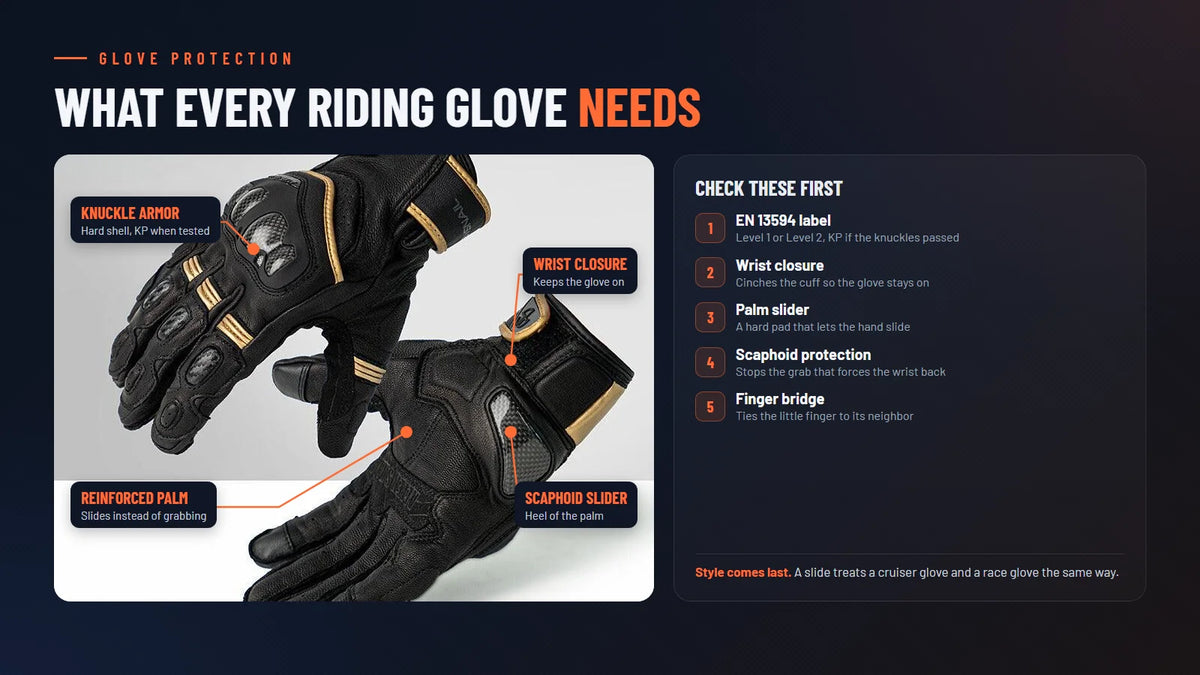
Every motorcycle glove for road riding should have an EN 13594 certification, a secure wrist closure, palm sliders or a reinforced palm, scaphoid protection and a little-finger bridge, whatever its type. These features matter more than the glove's style, because a slide treats a cruiser glove and a race glove the same way.
EN 13594:2015, the European standard for protective gloves for motorcycle riders, is still the current edition as of 2026. It has two levels. Level 1 is the lighter, more flexible tier, and Level 2 sets tougher abrasion, cut and tear thresholds, makes knuckle impact testing mandatory and requires the palm to last an average of at least 8 seconds on the abrasion machine. "KP" beside the level number means the knuckle protection passed the impact test, which is optional at Level 1. The full label breakdown sits in motorcycle gear certifications.
Four glove features beyond the label decide how a glove behaves in a crash, listed here by importance.
- A glove's wrist closure cinches the cuff so the glove stays on your hand, and EN 13594 checks it with a pull-off (restraint) test.
- A glove's palm slider is a hard, low-friction pad that lets the hand slide along the road instead of gripping it.
- A glove's scaphoid protection sits at the heel of the palm, where pads such as Knox's Scaphoid Protection System stop the "grab" that forces the wrist back. The scaphoid is a small wrist bone often broken in a fall onto an outstretched hand.
- A glove's finger bridge links the little finger to the ring finger, so the little finger can't roll or bend back in a slide.
No glove prevents every injury. A certification label shows the glove passed lab tests for abrasion, cut, tear and impact, not that it stops a broken bone.
Are fingerless motorcycle gloves safe?
No, fingerless motorcycle gloves are the least protective riding gloves on sale, because they leave your fingertips and finger joints bare to the road. They still give grip, vibration damping and some palm coverage compared with bare hands. Keep them for short, slow rides and wear full-finger gloves at highway speed.
Do you need separate summer gloves?
Yes, riders in hot climates need a separate pair of summer gloves, because a touring or winter gauntlet soaks your hands in sweat on an Arizona afternoon. A vented summer glove keeps the knuckle armor and palm reinforcement and swaps solid panels for perforated leather or mesh.
The choice between those two materials is laid out in Ventilated Summer Motorcycle Gloves.
How should motorcycle gloves fit?
Motorcycle gloves should fit snug, with your fingertips close to the ends of the glove fingers, a flat palm with no loose folds and a closure that stops the glove pulling off. Make a fist and grip the bars in your riding position, since a glove that fits standing up can pinch at the knuckles on the bike.
AtomBiker, a US online store for motorcycle helmets, jackets, gloves, boots and pants, sizes gloves by measuring the dominant hand around the knuckles with fingers together and thumb out. Its Sizing Guide starts at S (7-7.5 in, 18-19 cm) and tops out at 3XL (9.5-10 in, 24-25 cm). Between sizes, go smaller for leather and larger for textile. The full measuring method is in Motorcycle Glove Sizing.
Should you choose leather or textile gloves?
Choose leather gloves for lever feel and a fit that breaks in to your hand, and choose textile gloves for easy waterproofing and lighter weight. Both materials pass EN 13594 when the glove is built for it, so the label tells you more about protection than the material does. Owning both, leather for dry days and a textile membrane glove for rain, covers every season. The trade-offs by climate and cost are compared in Leather vs Textile Motorcycle Gloves.
Frequently asked questions
What is the difference between racing and touring gloves?
Racing gloves put crash protection first, with hard knuckle armor, palm sliders, a finger bridge and a full gauntlet, while touring gloves trade some of that armor for weather sealing and all-day comfort. Touring gloves usually add a waterproof membrane and a visor wiper. A racing glove suits a tucked riding position, and a touring glove suits an upright one.
Are gauntlet gloves safer than short-cuff gloves?
Yes, gauntlet gloves are safer than short-cuff gloves, because the long cuff covers the wrist and overlaps the jacket sleeve. EN 13594 Level 2 requires a cuff that reaches at least 2 in (50 mm) past the wrist line, which a glove ending at the wrist bone doesn't meet. Short cuffs run cooler and tuck under the sleeve, which is why commuters and summer riders choose them.
Are heated motorcycle gloves worth it?
Yes, heated gloves are worth it for riders who keep riding through the cold months, because insulation alone only holds the heat your hands already make. Wired 12V gloves draw power from the bike, while battery gloves (7V in Gerbing's range) work on any bike without wiring. AtomBiker's motorcycle gloves collection includes heated and insulated winter gloves alongside racing, touring and cruiser styles.
Are motocross gloves OK for street riding?
No, motocross gloves are a poor choice for street riding, because they're built thin and light for grip, with minimal crash armor. EN 13594 is written for on-road gloves, so a street glove with a palm slider and tested knuckle protection suits highway speeds far better.
Do motorcycle gloves need knuckle armor?
Yes, road riding gloves need knuckle protection, because the back of the hand takes direct impacts when a hand hits the ground or the bike. EN 13594 makes tested knuckle protection (the KP mark) mandatory at Level 2 and optional at Level 1.
Should gloves go over or under your jacket sleeve?
Gauntlet gloves go over the jacket sleeve and short-cuff gloves tuck under it, so the glove and jacket overlap at the wrist with no skin showing. In steady rain, tucking the cuff under the sleeve stops water from running down your arm into the glove.
Shop this guide
Start with the right questions.
Compare construction, fit and features. Open each product for its available sizes, current price and stated certifications.