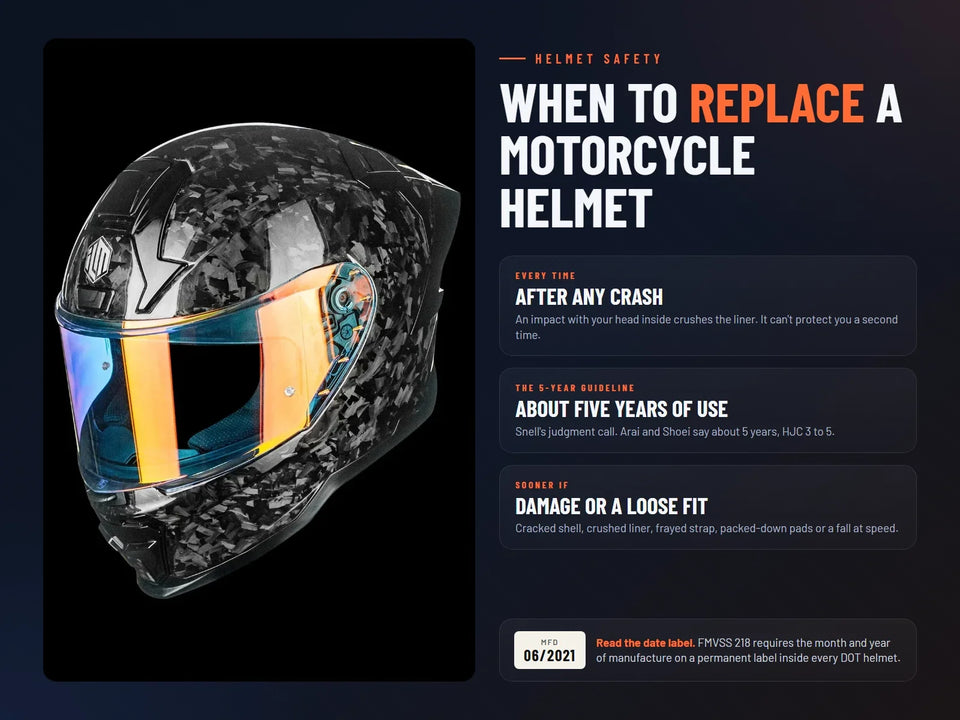

Replace a motorcycle helmet right after any crash in which it hit something with your head inside, and after about five years of normal use even when it looks fine. Replace it sooner if the shell or liner is damaged, if worn pads leave it loose on your head, or if it fell off a moving bike.
The five-year figure is the Snell Memorial Foundation's judgment call, based on testing of helmets worn by the California Highway Patrol, and Arai, Shoei and HJC publish intervals close to it. A helmet's age comes from the month and year of manufacture that FMVSS 218, the US federal motorcycle helmet standard, requires on a permanent label inside the shell. A drop from your hand or the seat usually isn't a replacement trigger, though HJC warns that a 4-foot drop can damage a helmet.
When should you replace a motorcycle helmet?
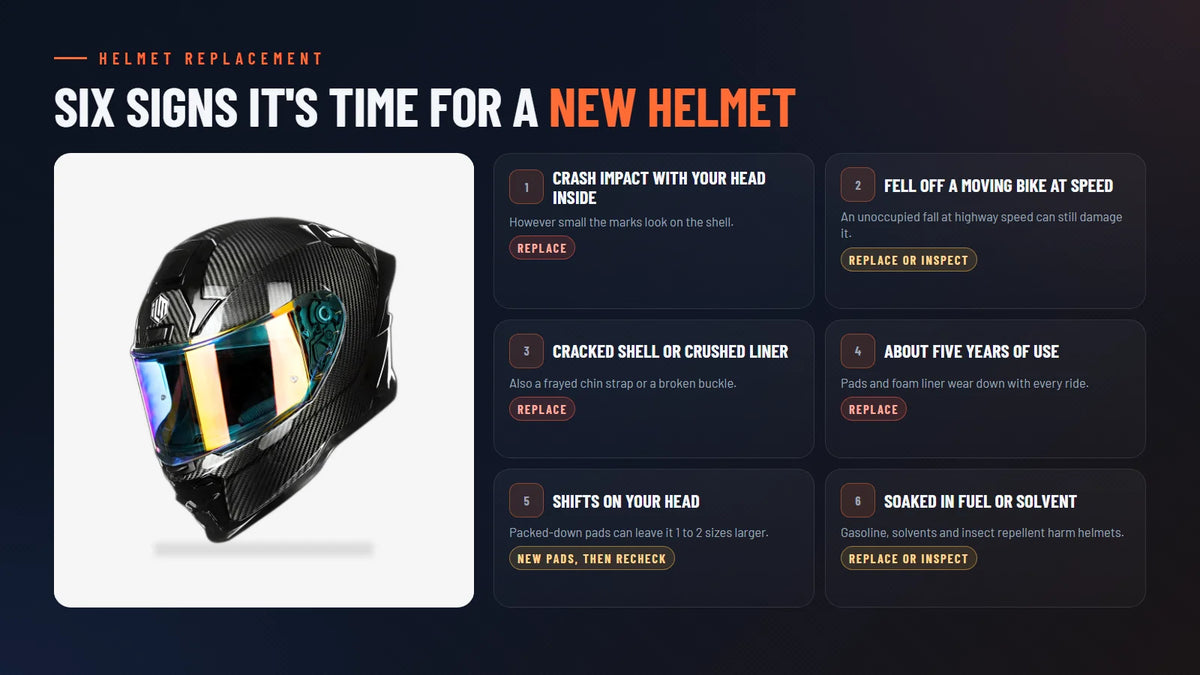
Replace a motorcycle helmet as soon as any one of six triggers applies, and the first two end a helmet's life on the spot.
- A crash impact with your head inside the helmet means replacement, however small the marks look.
- A helmet that fell off a moving bike at highway speed needs replacing or a maker's inspection.
- A helmet with a cracked shell, crushed liner, frayed chin strap or broken buckle needs replacing.
- A helmet past five years of normal use is due for replacement, even with no visible damage.
- A helmet that now shifts on your head after the pads packed down needs new pads, or a new helmet if the fit stays loose.
- A helmet soaked in gasoline, solvent or insect repellent needs a maker's inspection or replacement.
A helmet that slid off the seat isn't on the list. The Snell Memorial Foundation says most drops like that don't call for a new one.
Where does the 5-year guideline come from?
The 5-year rule started with the Snell Memorial Foundation, which calls it a judgment call based on testing of helmets used by the California Highway Patrol, work done by Dr. George Snively. Snell's FAQ explains the wear: putting a helmet on and taking it off damages the comfort pads and the energy-absorbing foam liner over time.
Worn pads matter more than most riders think. Snell says they can leave a helmet at least one to two sizes larger than it was new, so it's more likely to shift or come off in a crash.
Helmet makers land close to Snell's number.
- Arai's US warranty page says all Arai helmets should be replaced within 5 years of first use, and lists sweat, haircare products, cleaners, polishes, pollution and UV light as things that age a helmet even with little use.
- Shoei's European FAQ says to replace a helmet after about 5 years of normal use, care and storage.
- HJC's US site sets a shorter helmet interval: every 3 to 5 years, depending on how much you use it.
The sources disagree by up to two years at the short end, so the maker's own figure for your helmet is the one to follow.
How do you find your helmet's age?
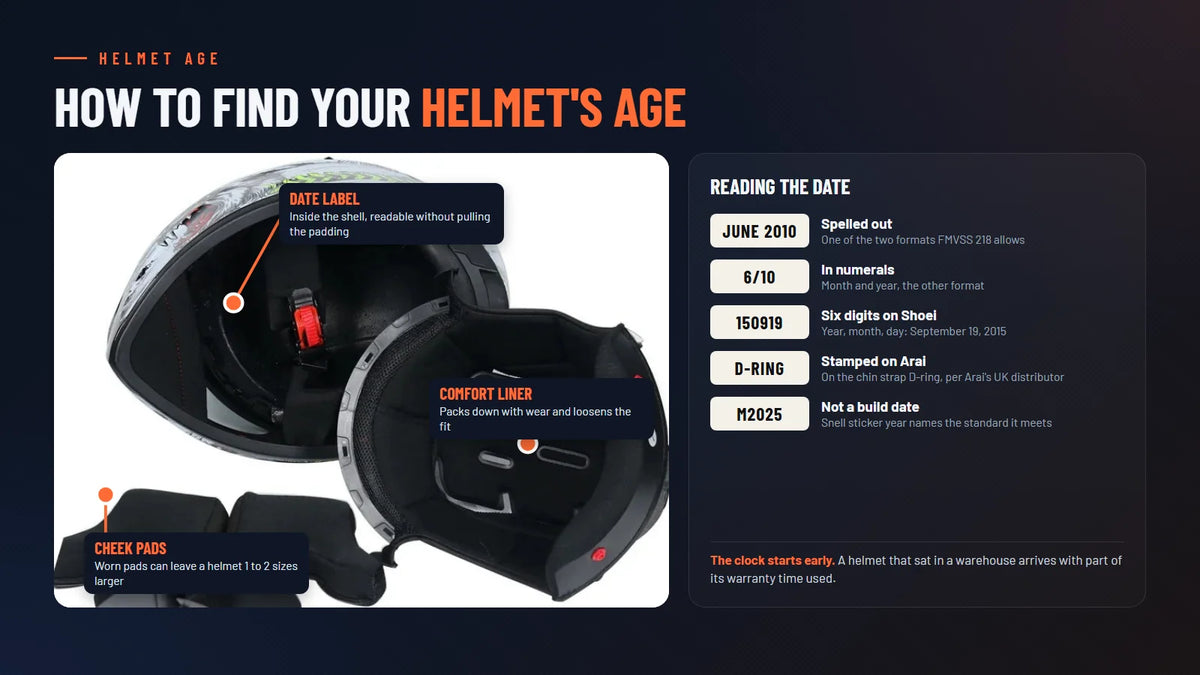
Your helmet's age is printed inside it. FMVSS 218, the US Federal Motor Vehicle Safety Standard for motorcycle helmets, requires a permanent label showing the month and year of manufacture, readable without removing the padding. The standard allows the date spelled out (June 2010) or in numerals (6/10).
Makers place and format the date differently. Shoei puts its production date on a sticker under the center pad, either with the month spelled out (Mar/11/2007) or as six digits in year, month, day order, so 150919 means September 19, 2015. Arai's UK distributor says Arai stamps the date on the chin strap's D-ring.
Don't confuse the date with the certification year. The "M2020" or "M2025" on a Snell sticker names the Snell standard the helmet meets, not the year it was made.
The date matters on a new helmet too. Arai's warranty ends no more than 7 years from the date of manufacture, and Shoei's US warranty runs five years from purchase or seven years from manufacture, whichever comes first. A helmet that sat in a warehouse for two years arrives with part of that time already used.
Should you replace a helmet after a crash?
Yes, replace a motorcycle helmet after any crash in which it struck the road, a vehicle or anything else with your head inside, even when the shell looks clean. The Snell Memorial Foundation says crash helmets are built to manage a severe impact in a single accident, and its FAQ is plain about the rest: a damaged helmet can't protect the brain a second time.
The label inside every DOT helmet says the same thing. FMVSS 218 requires this instruction to the buyer: "If helmet experiences a severe blow, return it to the manufacturer for inspection, or destroy it and replace it." HJC puts it in capitals: "Your helmet is only designed for ONE impact."
Inspection is a real option for a hit you aren't sure about. Shoei offers US riders a free impact inspection of any Shoei helmet through its US distributor, Helmet House, with free return ground shipping. Arai says a helmet with any doubt about its protection should go back to the manufacturer for competent inspection or be discarded.
Should you replace a helmet you dropped?
No, a helmet dropped from your hand or off a motorcycle's seat or handlebar usually doesn't need replacing, according to the Snell Memorial Foundation, because the impacts that damage a helmet are the ones with a head inside it. Snell adds two limits: frequent dropping or spiking a helmet on hard surfaces can degrade it over time, and a helmet that falls to the ground unoccupied at highway speed may be damaged.
HJC takes a harder line. Its US site says "Any impact in a crash or a drop from as low as 4 feet is enough to damage your helmet." Shoei's European FAQ sits between the two: a fall from a low height usually marks only the paint or attachments, while a visibly damaged outer shell means replacing the helmet right away.
The makers and Snell don't agree on drops, so lean on Snell's own fallback. If you suspect a helmet is compromised, replace it or send it to the maker for inspection.
How do the replacement triggers compare?
The replacement triggers compare by how firm the verdict is: a crash ends a helmet's life every time, while a drop or a loose fit depends on the details.
| Trigger | Replace? | Why | Source |
|---|---|---|---|
| Crash impact with your head inside | Yes, every time | The liner absorbs one severe impact by crushing and can't protect a second time | Snell Memorial Foundation FAQ; FMVSS 218 label text |
| Unoccupied fall at highway speed | Yes, or get a maker's inspection | A fall at highway speed may degrade the helmet's protection | Snell Memorial Foundation FAQ |
| Visibly damaged outer shell | Yes, right away | Shell damage is the one sign a rider can see without an inspection | Shoei Europe FAQ |
| Five years of normal use | Yes | Daily wear breaks down the comfort pads and foam liner | Snell FAQ; Arai; Shoei Europe |
| Loose fit after pads pack down | New pads first, a new helmet if it stays loose | Worn pads leave a helmet one to two sizes larger than new | Snell Memorial Foundation FAQ |
| Drop from your hand, seat or handlebar | Usually no; inspect it | Damaging impacts come with a head inside, though HJC warns a 4-foot drop can damage a helmet | Snell FAQ; HJC |
| Contact with gasoline, solvents or insect repellent | Inspect; replace if in doubt | Common substances can damage a helmet with no visible sign | FMVSS 218 label text; HJC |
How do you make a helmet last its full life?
A motorcycle helmet lasts its full five years when you keep it away from heat and fuel and protect the liner from knocks. These care habits come straight from Snell's FAQ and the makers' own instructions.
- Keep the helmet away from high heat such as a hot muffler, which Snell warns can melt the foam liner.
- Don't hang the helmet on a mirror or handlebar, because a hard edge pressing into the liner dents the foam.
- Keep the helmet away from gasoline, gasoline fumes and insect repellent, both on HJC's list of things that damage helmets.
- Clean the helmet's pads with mild soapy water only, and use no chemical cleaners inside or out, as Snell advises.
- Store the helmet in its bag between rides, which HJC recommends to cut down on surface damage.
Pads still pack down with use, however well you store the helmet. Rerun the checks in how a motorcycle helmet should fit whenever the helmet starts to feel roomier.
Do helmets expire on a shelf?
No, an unused helmet stored in good condition doesn't automatically expire after five years, according to the Snell Memorial Foundation. Storage still counts, so keep a spare helmet bagged and away from heat and fuel, and read its date label before the first ride.
Can you sell or donate an old helmet?
No, selling or giving away a helmet that has crashed or passed its replacement age hands the next rider a risk they can't see, since Snell says damage is hard to judge without a trained inspection. Cut the chin strap before the helmet goes in the trash, so nobody pulls it out and rides in it. The buyer's side of this question is covered in how to choose a motorcycle helmet by riding style and head shape.
Where can you find a replacement motorcycle helmet?
AtomBiker, a US online store for motorcycle helmets, jackets, gloves, boots and pants, carries full-face, modular, open-face 3/4, off-road and dual-sport helmets in its replacement motorcycle helmets collection. When the new helmet arrives, note the manufacture date on its label and the date of your first ride, because those two dates set its replacement deadline.
Frequently asked questions
Is the five-year helmet rule a law?
No, the five-year rule is a recommendation, and the Snell Memorial Foundation itself calls it a judgment call. FMVSS 218 requires a helmet to show its month and year of manufacture but sets no replacement age. What each label on a helmet does certify is laid out in motorcycle gear certifications.
Is a 10-year-old motorcycle helmet safe to wear?
No, a 10-year-old helmet that's been ridden in is past every replacement interval published by Snell, Arai, Shoei and HJC, all of which top out at five years of use. Its pads and liner have had twice that long to wear, so replace it even if the shell still looks good.
How long does a motorcycle helmet last if you ride every day?
A motorcycle helmet worn every day lasts about 3 to 5 years, the range HJC gives depending on how much you use it. Daily on-and-off wear packs the pads fastest, and Snell says worn pads can leave a helmet one to two sizes larger than new.
Does a helmet warranty cover crash or drop damage?
No, helmet warranties cover defects, not damage from crashes or drops. Shoei's US FAQ says damage caused by the owner, such as dropping the helmet, isn't covered, and Arai's warranty excludes heat damage and improper handling or storage.
Do you need a new helmet when a new safety standard comes out?
No, a new standard doesn't retire a helmet you already own, so replace it on the usual triggers. A newer standard does add tests, such as the oblique impact test in ECE 22.06, the UN Economic Commission for Europe helmet regulation, which makes the newer label worth choosing on your next helmet.
Does a helmet need replacing after a tip-over in a parking lot?
Yes, if your head hit the ground while you were wearing it, because that's an impact in use. No, if the helmet was hanging on the mirror or sitting on the seat and simply fell, since Snell treats a drop from the seat or handlebar as usually harmless. Inspect the shell either way.
Shop this guide
Start with the right questions.
Compare construction, fit and features. Open each product for its available sizes, current price and stated certifications.