Yes, a helmet with an internal drop-down sun visor is worth it for commuters and touring riders who ride through changing light, because the tinted inner visor drops with one flick of a slider and flips up for tunnels, shade, dusk and night. Track riders, dirt riders and anyone who wants the fewest moving parts gain less from one.
The sun visor rides in a pocket between the outer shell and the foam liner, behind the clear face shield, and ECE 22.06 requires it to let through more than 20% of light. Its costs are a lighter tint than dark sunglasses, extra moving parts and, in Arai's view, less room for impact foam at the brow. ECE 22.06 runs its impact tests with the sun shield lowered, while the DOT standard has no visor rules at all. Some US states, including Louisiana and Washington, ban tinted eye protection after dark, which a flip-up sun visor sidesteps.
Are internal sun visor helmets worth it?
Yes, internal sun visor helmets are worth it for riders whose light changes during a ride, such as commuters, touring riders and riders who wear glasses, and they're worth less to track and dirt riders.
Each rider type below gets a clear yes or no, with the reason.
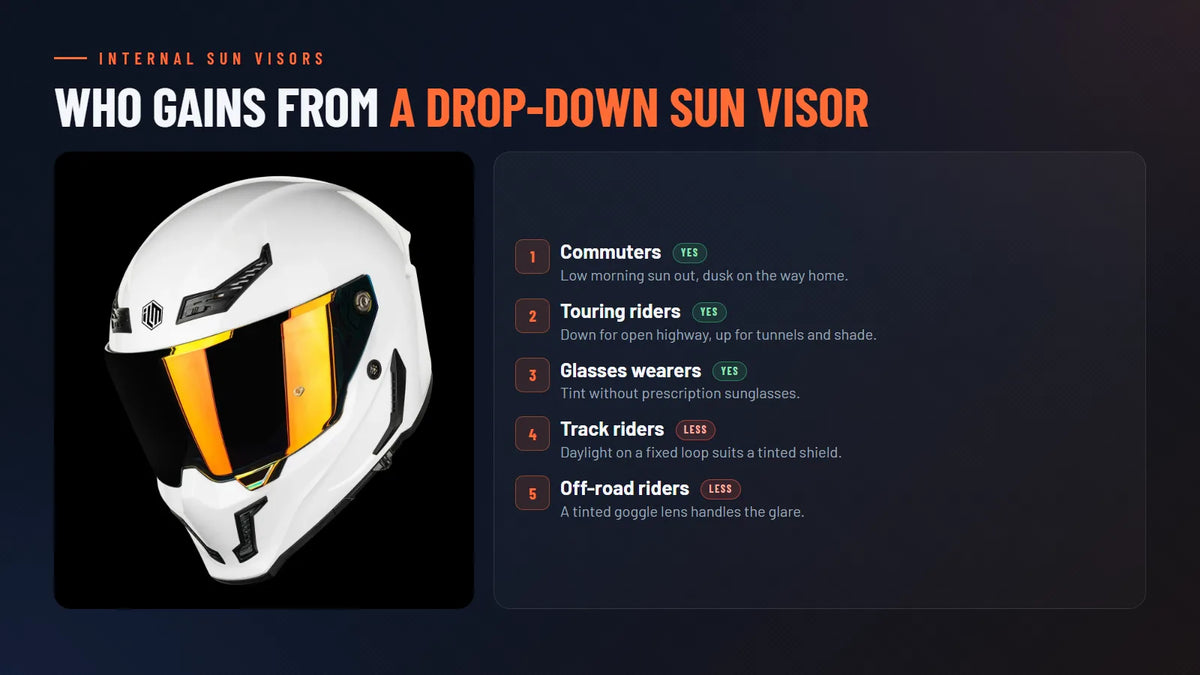
- Commuters get the most from an internal sun visor, because a ride into low morning sun and a ride home at dusk need tint for one and a clear view for the other.
- Touring riders use an internal sun visor all day, dropping it for an open Arizona interstate and raising it for tunnels, tree cover and the last hour before dark.
- Riders who wear prescription glasses get tint from an internal sun visor without buying prescription sunglasses.
- Track riders gain little from an internal sun visor, because a track day runs in daylight on a fixed loop, where a tinted face shield does the same job with fewer parts.
- Off-road riders gain little from an internal sun visor, because a motocross helmet takes goggles, and a tinted goggle lens handles glare.
The test is simple. A rider who would otherwise carry sunglasses or a spare shield on most rides should buy the sun visor.
How does an internal drop-down sun visor work?
An internal drop-down sun visor works as a tinted second visor stored inside the helmet shell above the eye port, which slides down behind the clear face shield when you push a slider or lever. ECE 22.06, the UN Economic Commission for Europe helmet regulation, calls it a sun shield and defines it as an additional tinted screen, used together with a clear visor, that covers the eyes.
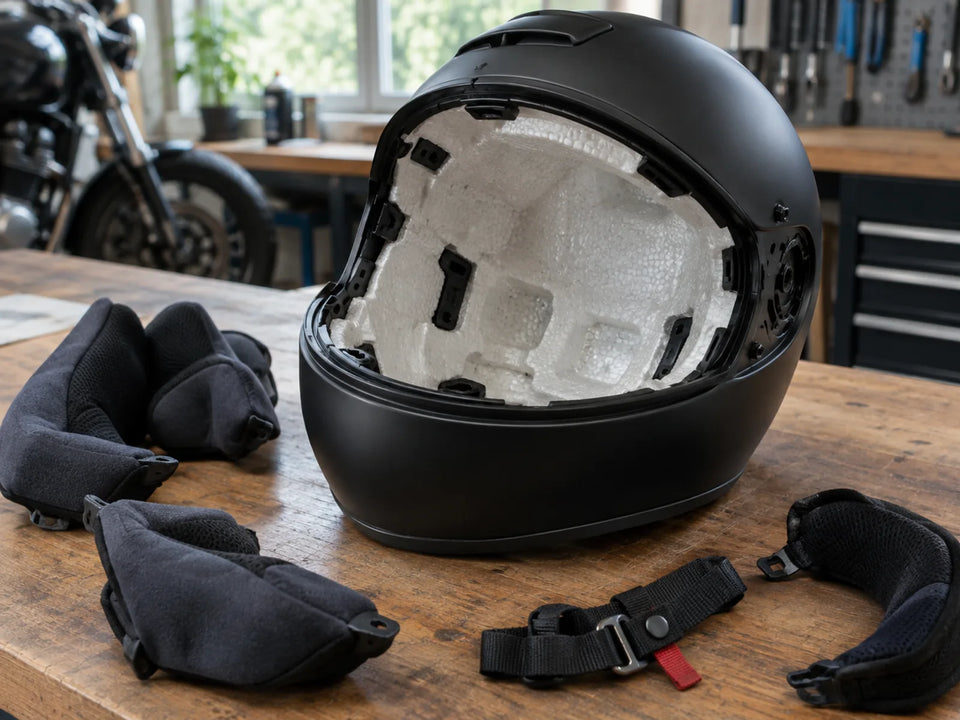
Arai describes where it lives: between the outer shell and the EPS liner, the expanded polystyrene foam that absorbs impact energy, across the front and sides of the head. The control is usually a slider on the lower left edge of the shell, though placement varies by model, and some sun visors are spring-loaded, so a button sends them back up.
ECE 22.06 sets two rules for the movement. The sun shield can't stop the clear visor from opening or closing, and one simple movement has to clear it out of your field of view.
Positions vary by model. Arai says internal sun shades offer only up or down, while Nolan's N87 owner's manual describes intermediate positions for its VPS sun visor, so check the helmet you're considering.
What are the pros of an internal sun visor?
The main pros of an internal sun visor are tint on demand without a stop and a clear face shield that stays in place for tunnels, shade and night riding.
An internal sun visor has four pros, and the first one matters most.
- An internal sun visor switches between clear and tinted without pulling over to swap shields or dig sunglasses out of a pocket.
- An internal sun visor flips up for a tunnel, a shaded canyon road or dusk, while the clear outer shield stays on for the ride home after dark.
- An internal sun visor keeps frames out of the helmet for riders who would otherwise wear sunglasses under it.
- An internal sun visor filters UV light: Shoei lists a UV filter above 99% for its QSV-1 sun visor, and AGV says the K3's polycarbonate sun visor offers protection from UV radiation.
What are the cons of an internal sun visor?
The main cons of an internal sun visor are a tint lighter than dark sunglasses, extra moving parts and a pocket at the brow where Arai would rather keep full EPS thickness.
An internal sun visor has six cons, and the first two matter most.
- An internal sun visor's tint has a floor: ECE 22.06 requires a sun shield to let through more than 20% of light, Shoei's QSV-1 lets through 23-29%, and Nolan's N87 manual still suggests sunglasses on very bright days for long trips.
- An internal sun visor takes a pocket between the shell and the EPS liner at the brow, which Arai avoids by mounting its shade outside the face shield.
- An internal sun visor stops short on some helmets, leaving a strip of bright light along the bottom of your view, and on others it rests on the bridge of your nose.
- An internal sun visor adds a slider, a pivot and a second surface to keep clean and free of scratches.
- An internal sun visor is a distraction to work mid-ride, and HJC's F100 manual tells riders to avoid operating the sun shield while riding, because the moving shade can block vision for a moment.
- An internal sun visor fogs when lowered in cold, damp air, and the fixes are in our guide to stopping helmet visor fog.
How do an internal sun visor and a tinted face shield compare?
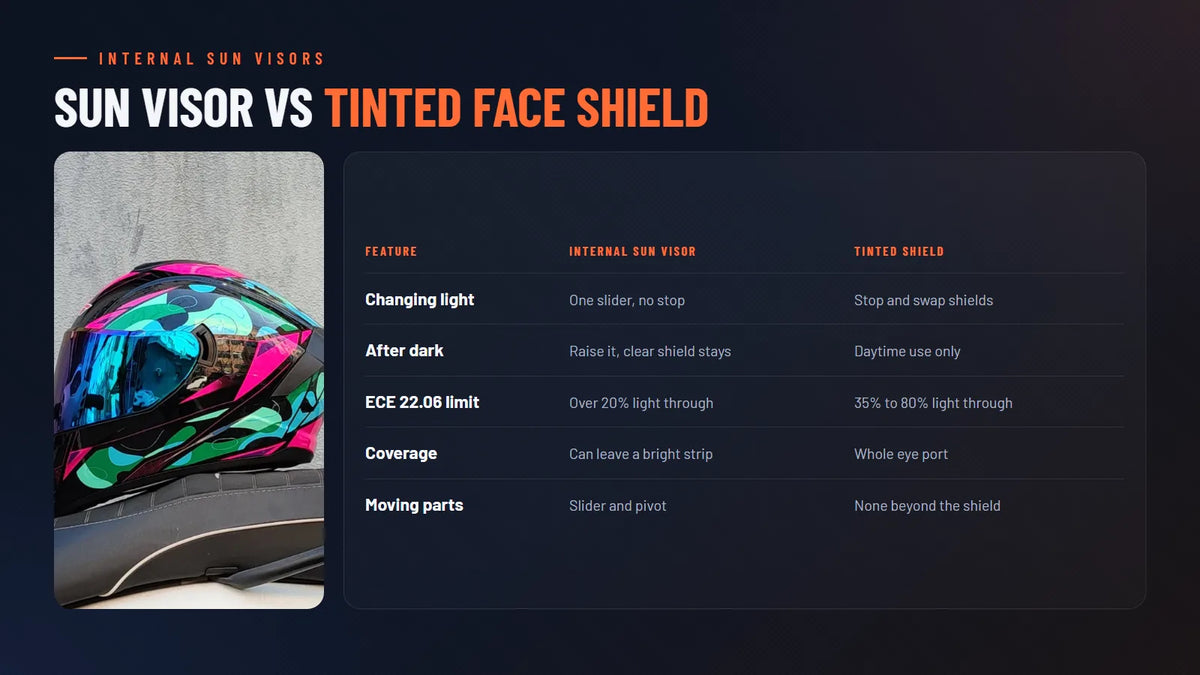
An internal sun visor wins on switching between bright and dark conditions, and a tinted face shield wins on simplicity and full coverage of the eye port.
The two ways to put tint in front of your eyes differ on switching, night use, light limits and parts.
| Feature | Internal drop-down sun visor | Tinted face shield |
|---|---|---|
| Where the tint sits | Inside the shell, behind a clear face shield | In the outer face shield itself |
| Changing light | One slider drops or raises it, no stop needed | Stop and swap to a clear shield |
| Riding after dark | Raise it; the clear shield stays on | Not suitable; ECE marks it "DAYTIME USE ONLY" |
| ECE 22.06 light limit | More than 20% light transmission | 35% up to 80% light transmission, marked for daytime use |
| Eye port coverage | Can leave a bright strip at the bottom | Covers the whole eye port |
| Layers in front of your eyes | Two (shield plus sun visor) | One |
| Moving parts | Slider, pivot, sometimes a spring | None beyond the shield |
| Which helmets take it | Only models built with one | Any helmet with a tinted shield made for that model |
| What to carry | Nothing extra | A clear shield for after dark |
Does an internal sun visor reduce helmet protection?
No, an internal sun visor doesn't drop a helmet below its certification, because ECE 22.06 runs its impact tests on helmets sold with a sun shield with the shade in its working, lowered position. What no standard measures is how much safety margin the visor pocket costs above that pass line.
Arai makes the case against internal shades. Its Pro Shade System mounts outside the face shield, and Arai says that keeps maximum EPS thickness across the front and sides of the head, where an internal lens and its pivot would sit, and lets its helmets keep their Snell rating.
Test results point the other way for some models. SHARP, the UK government's Safety Helmet Assessment and Rating Programme, gave five stars, its top rating, to the HJC FG-ST, a helmet listed with a drop-down sun visor, in November 2016.
FMVSS 218, the Federal Motor Vehicle Safety Standard behind the DOT label, contains no visor or sun visor requirements, so the DOT sticker says nothing either way. As of 2026, no published study or rating program isolates what a sun visor pocket does to impact protection. Treat the label as the test: DOT is the legal US minimum, and ECE 22.06 adds a test run with the shade down. The labels are decoded in our motorcycle gear certifications guide.
Are tinted visors legal at night?
No, a tinted visor is a daytime-only visor under ECE 22.06, which requires any visor below 80% light transmission to carry a "DAYTIME USE ONLY" marking, and some US states ban tinted eye protection after dark. Louisiana's law (R.S. 32:190.1) says eye protective devices used at night shall not be tinted, and Washington's rule (WAC 204-10-026) bans them between half an hour after sunset and half an hour before sunrise. An internal sun visor sidesteps the problem, since it flips up and leaves the clear shield in place.
Can you add a sun visor to any helmet?
No, an internal sun visor has to be designed into a helmet, because its pocket and pivot sit between the shell and the EPS liner. Never cut the EPS foam to make room for one.
A helmet without a sun visor takes tint in three other ways: a tinted or photochromic face shield made for that model, a tinted anti-fog insert such as Pinlock's Dark Smoke lens, or an external flip-down shade like Arai's Pro Shade System on Arai shields. A rider set on an internal sun visor should choose it at purchase, alongside riding style and head shape, the order laid out in our guide to choosing a motorcycle helmet by riding style and head shape.
Where can you see a dual-visor full-face helmet?
AtomBiker, a US online store for motorcycle helmets, jackets, gloves, boots and pants, lists the ILM MF509 Pro as a dual-visor full-face helmet, with DOT and ECE in its title and a "Dual Visor System with Pinlock70" in its features. The product page doesn't name the ECE edition, so check the label on the helmet for 22.06 or 22.05, and work the second visor during your fit check while the 30-day return window is open.
Frequently asked questions
Can you use an internal sun visor at night?
No, raise an internal sun visor before dark. HJC's F100 manual says not to use the sun shield at night, and AGV's K3 manual says never to use its sun visor at night, at dawn, at sunset or in poor visibility.
Can you ride with the face shield open and the sun visor down?
No, keep the clear face shield closed whenever the sun visor is down. HJC's F100 manual says the sun shield doesn't provide eye protection, and Nolan's N87 manual says its sun visor doesn't replace the protection of the main visor.
Can you replace a scratched internal sun visor?
Yes, helmet makers sell replacement sun visors for their models. Shoei sells the QSV-1 as a spare part with a clip mount it says comes off and goes on within seconds, and it tells owners to use only visors made for their helmet model.
What does dual visor mean on a motorcycle helmet?
Dual visor means the helmet has two visors: a clear outer face shield and an internal tinted sun visor that drops down behind it. Dual-visor designs come as full-face and modular helmets, and a full-face version keeps the fixed chin bar described in our full-face helmet chin bar guide.
Does an internal sun visor work with glasses?
Yes, an internal sun visor works with glasses when the lowered visor clears your frames and the bridge of your nose. Lower it during the try-on with your riding glasses in place.
Is an internal sun visor darker than a tinted face shield?
Not always. ECE 22.06 lets a sun shield go down to just over 20% light transmission, darker than the 35% floor for a daytime face shield, but Shoei's QSV-1 sun visor (23-29%) and its Dark Smoke shield (24-30%) are almost the same shade.
Shop this guide
Start with the right questions.
Compare construction, fit and features. Open each product for its available sizes, current price and stated certifications.