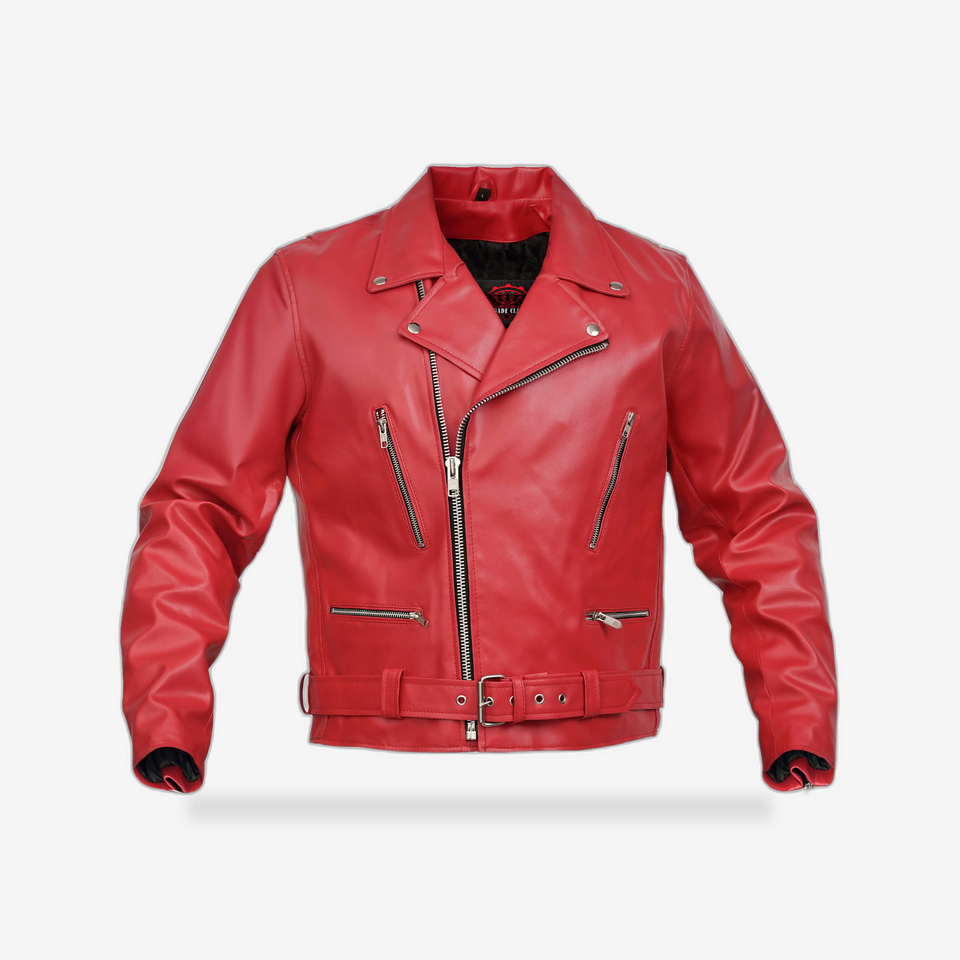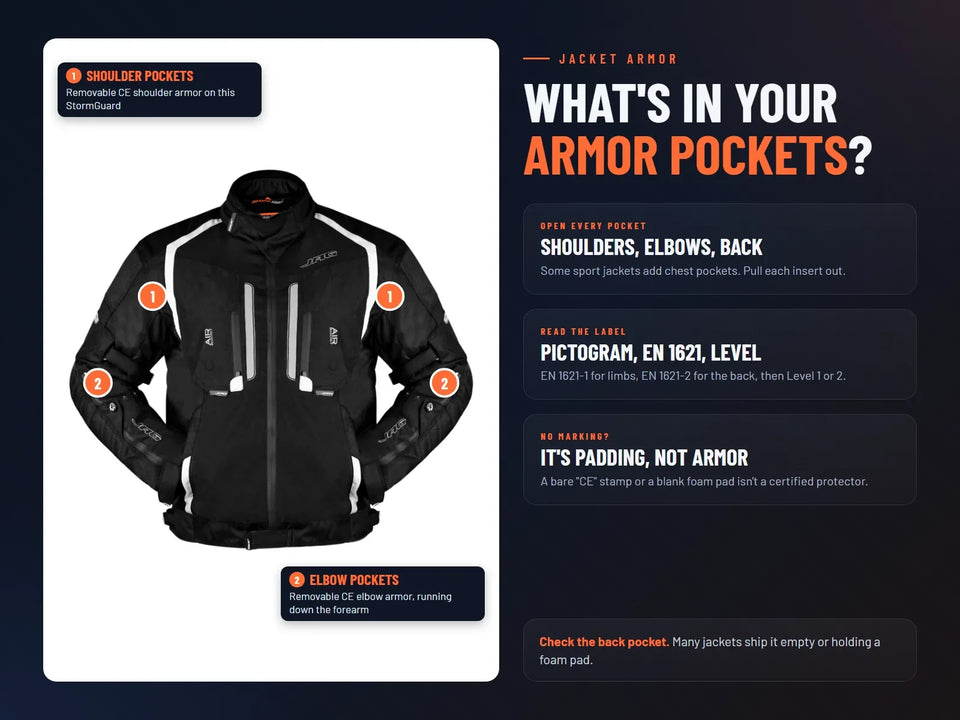

To check what armor your motorcycle jacket has, open the armor pockets at the shoulders, elbows, back and chest, pull out each insert and read its marking. Certified armor shows a motorcyclist pictogram, EN 1621-1 (limbs) or EN 1621-2 (back) and Level 1 or 2. An unmarked insert is uncertified padding.
Most jackets place pockets at the shoulders, elbows and back, and some sport jackets add chest pockets. Unlike a foam pad, certified armor carries a full EN 1621 marking with a zone code, such as S for shoulder or E for elbow, and limb armor adds a Type A or B size. Back pockets often arrive empty or holding a foam pad, so a back protector is usually a separate purchase that has to match the pocket's shape and your torso length. A jacket with no pockets at all needs armor worn underneath instead.
How do you check what armor your jacket has?
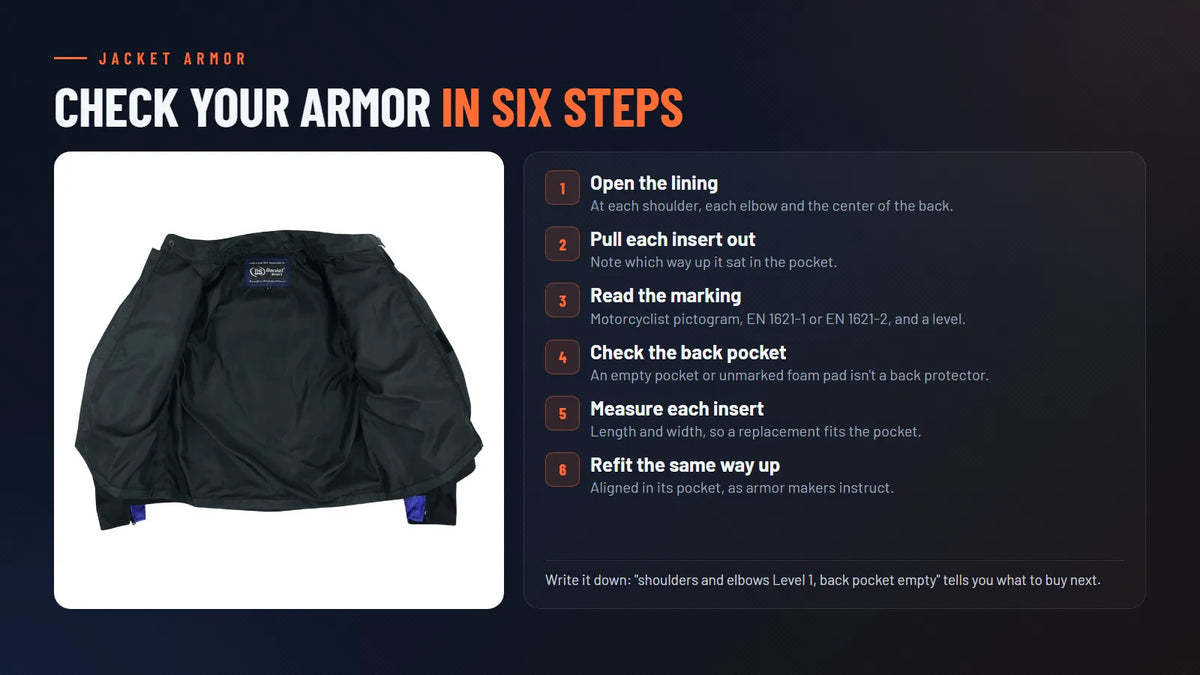
Check your jacket's armor by opening every pocket, pulling each insert out and reading the marking printed on it, a job that takes a few minutes at home.
Work through the jacket in this order, one pocket at a time.
- Open the jacket's lining at each shoulder, each elbow and the center of the back, and find the pocket flaps, most of which close with hook-and-loop fasteners.
- Pull each insert out of the jacket through its flap, noting which way up it sat.
- Read the marking printed on each jacket insert, looking for a motorcyclist pictogram, EN 1621-1 or EN 1621-2 and a level.
- Check the jacket's back pocket for an empty space or an unmarked foam pad, since neither one is a back protector.
- Measure each jacket insert's length and width with a tape, so any replacement fits the pocket.
- Slide each insert back into the jacket the same way up, aligned in its pocket, as armor makers such as SAS-TEC instruct.
Write down what you find. A note like "shoulders and elbows Level 1, back pocket empty" tells you exactly what to buy next.
Where are the armor pockets in a motorcycle jacket?
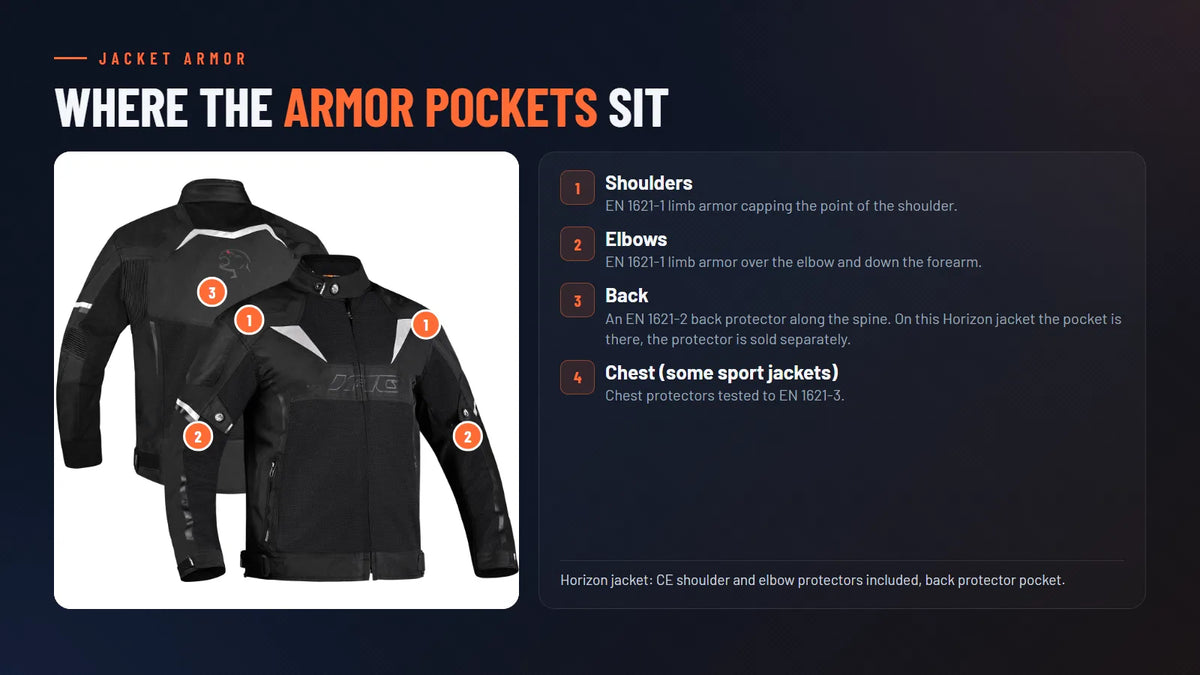
The armor pockets in a motorcycle jacket sit at the shoulders, elbows and back, and some sport jackets add pockets at the chest. The shoulder and elbow pockets cover the jacket's share of Zone 1 in EN 17092, the European garment standard's highest-risk zone, which the Belgian test lab Centexbel lists as shoulder, elbow, knee and hip.
Each armor pocket holds a different kind of protector.
- Shoulder pockets hold EN 1621-1 limb armor that caps the point of the shoulder.
- Elbow pockets hold EN 1621-1 limb armor that covers the elbow and runs down the forearm.
- The back pocket holds an EN 1621-2 back protector along the spine, and many jackets ship that pocket empty or with a foam pad.
- Chest pockets, found on some sport jackets, hold chest protectors tested to EN 1621-3, and Dainese's Racing 5 leather jacket has pockets for a two-piece chest protector sold separately.
How do you tell CE armor from a foam pad?
CE armor carries a printed EN 1621 marking and passed a motorcycle impact test, while a foam pad carries no marking and no test result. A third kind sits in between: armor certified for another sport, which carries a marking but not the motorcycle one.
The table compares the three on what you can check at home.
| Check | CE motorcycle armor | Armor certified for another sport | Foam pad |
|---|---|---|---|
| Marking | Motorcyclist pictogram, EN 1621-1 or EN 1621-2, level | A different pictogram and standard number | None, or a bare "CE" stamp |
| What was tested | Force passed through to the body in a motorcycle impact test | Impacts for another sport, such as skateboarding or cycling | Nothing |
| Build | Foam or a hard shell over padding, so feel proves little | Foam or hard shell | Often stiff foam with no ventilation holes |
| On a motorcycle | Certified for riding | Not certified for riding | No rated protection |
| After a crash | Replace after an impact | Follow its maker's guidance | Replace with CE motorcycle armor |
The marking is the test that counts. Squeezing a pad tells you little, because certified armor comes in both foam and hard-shell builds.
How do you read the label on a piece of armor?
Read an armor label by finding three codes next to the standard number: the zone the protector covers, its size type and its level.
Each code on the armor label answers one question.
- The zone code on a limb armor label names the body part: S for shoulder, E for elbow and forearm, H for hip, K for knee and upper shin, and L for the lower leg.
- The zone code on a back armor label names the coverage: FB for full back, CB for central back and LB for lower back.
- The type letter on a limb armor label gives the coverage size, with Type A protectors smaller than Type B protectors.
- The level number on any armor label shows the protection, and Level 2 lets less force through than Level 1.
T+ and T- marks show the armor passed optional hot and cold impact tests. What each level and temperature mark demands in the lab is covered in motorcycle gear certifications.
Can you add a back protector to your jacket?
Yes, you can add a back protector to any jacket with a back pocket, as long as the insert matches the pocket's shape and your torso length.
Pocket shapes vary widely. Rider Magazine found as many back protector pocket shapes as jacket styles, and makers often cut the pocket for their own insert: Dainese's Racing 5 pocket takes its G1 back protector up to jacket size 48 and the G2 from size 50 (European sizes).
Size the protector to your torso. SCOTT measures torso length from the waist line to the point where the shoulder meets the neck, and says a protector has to cover that area to work.
Then size the jacket around it. Size up if you'll add a back protector, and recheck the fit seated with the protector in place, using the checks in how tight a motorcycle jacket should be.
What if your jacket has no armor pockets?
A jacket with no armor pockets has nowhere to hold certified armor, so the fix is armor worn underneath it or a different jacket. Rider Magazine suggests strap-on back armor when a protector won't fit the pocket you have, and armored shirts such as Fly Racing's Barricade put armor under any jacket.
Recheck the jacket's fit with that armor on, since it takes up room the jacket was sized without.
MotoCAP, the Australian gear-rating program, states in its test reports whether a jacket has pockets for aftermarket protectors, a useful check before you buy. A missing pocket is one of the clearest signs of a fashion jacket rather than riding gear.
Can you upgrade foam pads to CE armor?
Yes, you can swap foam pads for CE armor when the new protector fits the pocket: measure the old pad and buy armor the same size or slightly smaller, as Rider Magazine advises. In Rider's test, a D3O Type A shoulder protector fit a jacket pocket where the larger Type B didn't. MotoCAP's 2021 rating of the Brixton Classic leather jacket also noted that replacing its shoulder and elbow armor with better-performing protectors would raise its protection.
Does armor need replacing?
Yes, replace armor after any crash impact, and plan to replace it with age. SAS-TEC says its protectors must be replaced after an impact and last about five years on average when handled properly, Rider Magazine suggests every five years or so, and SCOTT recommends replacing its back protectors three years after purchase, so makers don't agree on one age limit. A hard-shell protector with a cracked shell needs replacing right away, according to Motorcyclist (2019).
Where can you see a jacket with CE shoulder and elbow armor?
A jacket with CE shoulder and elbow armor lists that armor in its spec, and the inserts carry the EN 1621-1 marking described above. AtomBiker, a US online store for motorcycle helmets, jackets, gloves, boots and pants, lists removable CE-approved shoulder and elbow armor on its StormGuard all-season riding jacket, a 600D textile jacket with a removable thermal liner. The page doesn't name the armor level or a back protector, so run the pocket check above when it arrives.
Frequently asked questions
Do all motorcycle jackets come with armor?
No, some jackets ship with empty pockets and some have no pockets at all. Rider Magazine notes that most street and touring jackets include shoulder and elbow armor, sometimes with only a foam back pad, and what each style usually includes is covered in motorcycle jacket types.
Does a "CE" stamp prove armor is certified?
No, a bare "CE" stamp doesn't prove the armor passed a motorcycle test. Rider Magazine (2019) says armor without the full CE label can't be confirmed as tested even when it's stamped "CE", so look for the pictogram, the EN 1621 number and the level together.
Can you put knee armor in a jacket's elbow pocket?
Yes, when the protector is certified for both zones and fits the pocket. SAS-TEC marks one of its EN 1621-1 protectors E/K Type B, which means it's certified for the elbow and forearm or the knee and upper shin.
Should you take armor out before washing a jacket?
Yes, take the armor out before washing or cleaning the jacket, as SAS-TEC instructs. Clean the protectors separately with a damp cloth, then refit each one the same way up before you ride.
Does cold weather weaken jacket armor?
Yes, armor makers warn that very cold weather weakens some armor. SAS-TEC says temperatures below 14°F (-10°C) can reduce its protectors' protective effect, and armor with a T- mark passed the optional impact test at that temperature.
Does a back protector pocket mean a back protector is included?
No, a back protector pocket often comes empty or with a foam pad. REV'IT's Mile leather jacket, for example, is prepared for a Level 2 SEESOFT back insert that isn't included.
Shop this guide
Start with the right questions.
Compare construction, fit and features. Open each product for its available sizes, current price and stated certifications.