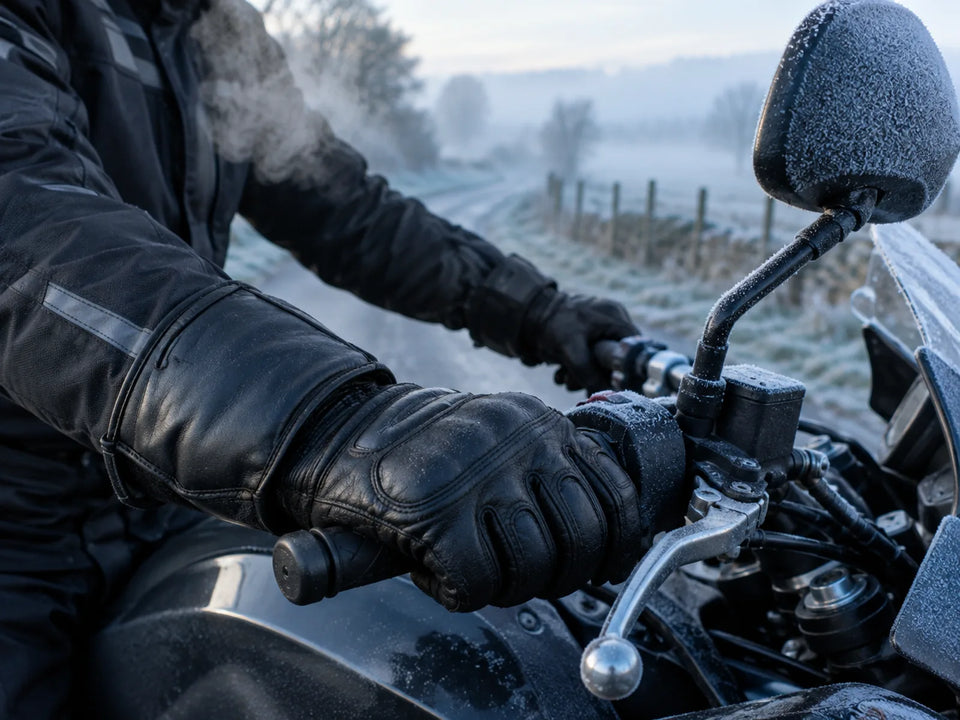

Battery heated gloves suit rides of a few hours and riders who swap bikes, because they need no wiring; 12V wired gloves suit all-day cold rides, because they draw power from the motorcycle and keep heating as long as the engine runs. Gerbing rates its 7V battery gear at roughly 2-8 hours depending on heat setting.
Battery gloves run on rechargeable lithium packs with a heat button on the glove, while wired gloves take power through a fused lead and a separate controller. Side by side, the two differ most in run time, setup and how easily they move between bikes. Gerbing's published specs put battery run time between 1 hour on high and 8 hours on low, and every wired setup starts with checking the bike's charging output against the gear's draw.
Which is better, battery or 12V wired heated gloves?
12V wired heated gloves are better for long rides in serious cold, and battery heated gloves are better for commutes, short trips and riders who use more than one bike. Gerbing, which sells both, calls 12V the stronger choice for all-day rides in serious cold and pitches its 7V battery gear at shorter trips, travel and wear off the bike.
Ride length decides it. A 40-minute commute each way fits inside a battery's run time on medium, and the same gloves keep working on the walk from the parking garage. A touring day near freezing outlasts a pack on its higher settings, and that's where a wire to the bike pays off.
Hybrid gloves split the difference. Gerbing's GT5 12V Hybrid runs from the bike's 12V system or from a separate 12V battery pack sold on its own.
How do battery-heated gloves work?
Battery-heated gloves work by sending current from a rechargeable lithium pack through fine heating wires sewn into the fingers, the back of the hand and, on some models, the palm. Gerbing's 7V Hard Knuckle gloves, for example, come with two 7.4V, 3,400 mAh packs rated at 25 Wh, heat both the palm and the back of the hand, and carry the heat to the fingertips.
A pack's watt-hour (Wh) rating is the energy it stores, and a bigger figure means a longer run at the same heat. Gerbing calls its heating element Microwire, thousands of ultra-fine conductive filaments woven into the garment.
A three-level control on the glove sets the heat. On Gerbing's 2,600 mAh packs, the button glows red for high, yellow for medium and green for low.
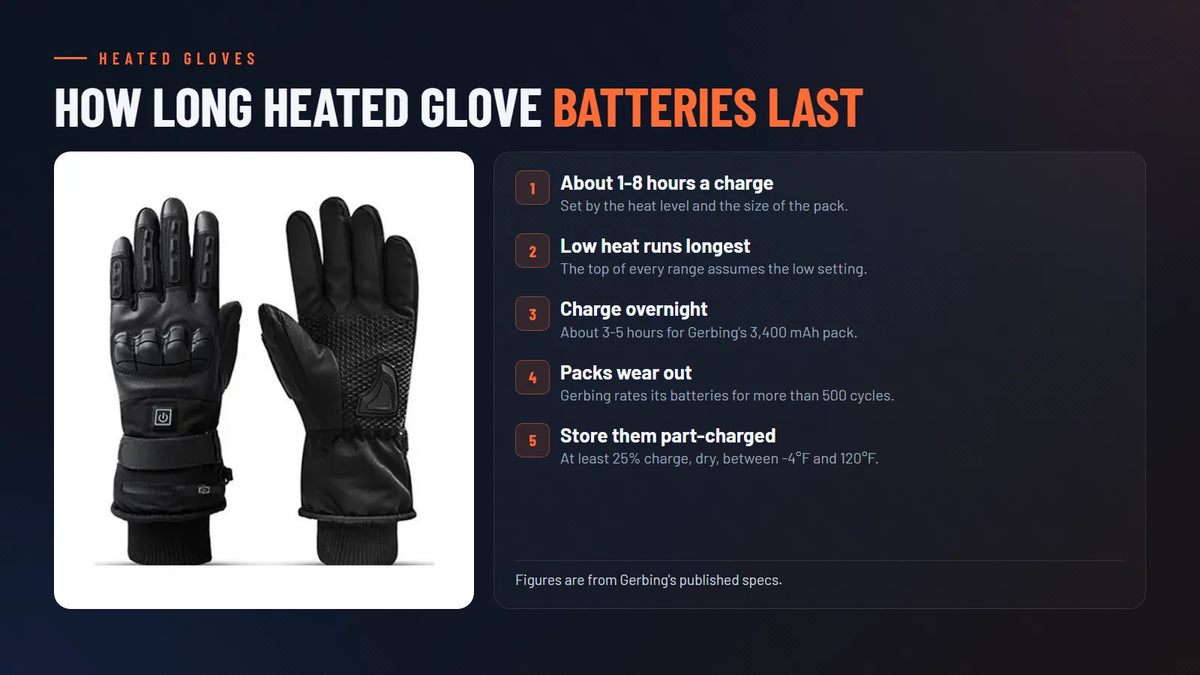
Charging takes about 3-5 hours for Gerbing's 3,400 mAh pack and 4-6 hours for its 2,600 mAh pack, so an overnight charge covers the next day's ride.
How do 12V wired heated gloves work?
12V wired heated gloves work by drawing current from the motorcycle's electrical system through a fused lead connected to the battery, with a controller between the bike and the gloves that sets the heat. Gerbing says every 12V installation needs its battery lead and a temperature controller, and Warm & Safe says all of its 12V gear has to run through a heat controller, which it sells separately.
The gloves plug into the sleeve of a heated jacket or straight into the controller, and the controller is where you turn the heat up or down.
Wired gloves draw a modest current. Warm & Safe lists its 12V touring heated gloves with I-Touch at 1.31 amps and 18.14 watts per glove at 13.8 volts, about 36 watts for the pair. Venture Heat lists its 12V glove liners at 1.2 amps (14.4 watts) per pair on high.
How do battery and wired heated gloves compare?
Battery and wired heated gloves reach similar peak heat, so the real differences are run time, setup, control and where the gloves go once you're off the bike.
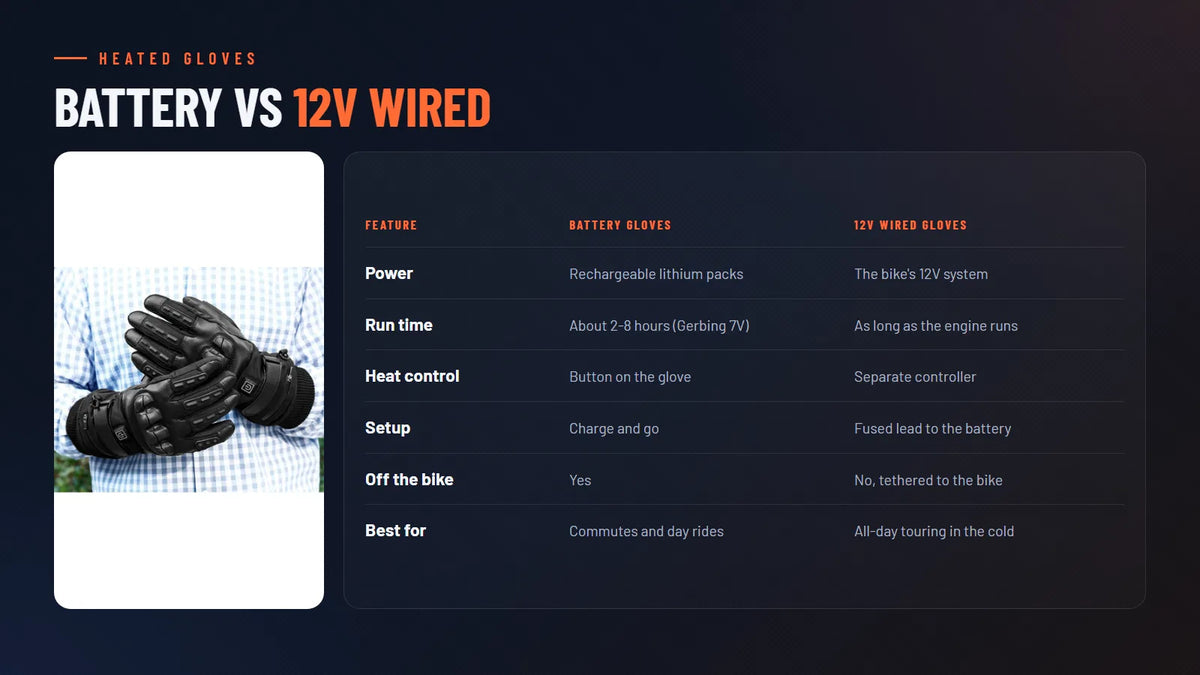
The table compares battery and 12V wired heated gloves on power, run time, heat control, setup and the rider each one suits.
| Feature | Battery heated gloves | 12V wired heated gloves |
|---|---|---|
| Power source | Rechargeable lithium packs (7.4V in Gerbing's 7V range) | The motorcycle's 12V electrical system |
| Run time | Limited by the pack: roughly 2-8 hours in Gerbing's 7V range | No limit while the engine runs (Gerbing) |
| Peak heat (Gerbing) | About 135-140°F (57-60°C) | About 135°F (57°C) |
| Heat control | Button on the glove, three levels on Gerbing's 7V gloves | Separate controller, often sold separately |
| Setup | Charge and go | One-time install of a fused battery lead |
| Cable on the rider | None | Cable from the glove to the jacket sleeve or controller |
| Moving between bikes | Easy | Needs a lead fitted to each bike |
| Use off the bike | Yes | No, the gloves are tethered to the bike |
| Ongoing upkeep | Charging, battery storage and eventual pack replacement | Checking cables and plugs for damage |
| Best for | Commutes, day rides and riders with several bikes | All-day touring in serious cold |
Heated gloves are one branch of the winter glove family in motorcycle glove types by riding style, and the power source decides how you'll live with them more than any styling detail does.
How long do heated glove batteries last?
Heated glove batteries last about 1-8 hours per charge, depending on the heat setting and the size of the pack, going by Gerbing's published specs. A battery's milliamp-hour (mAh) figure is its charge capacity, and the heat setting decides how fast that charge drains.
Gerbing's 7V guide gives roughly 2-8 hours depending on heat level, and its 7V Hard Knuckle gloves are rated for up to 8 hours of heat on their two 3,400 mAh packs. The GT5 12V Hybrid gloves, running from a separate 12V 9,000 mAh pack, are rated at 1 hour on high, 2.5 hours on medium and 4 hours on low.
Plan around the setting you'll actually use. The top of every range assumes low heat, so a rider who runs high on a 25°F morning lives at the bottom of it. Gerbing's guide puts low or medium as enough at about 50-64°F (10-18°C), with medium or high for colder rides.
Packs also wear out. Gerbing rates its batteries for more than 500 charge cycles with proper care.
What should you check before wiring heated gear?
Check that your motorcycle's charging system has spare output for the gear, that the lead is fused at the battery, and that the gear switches off before the engine does.
Run through these five checks before the first wired ride.
- Heated gear has to fit inside your bike's spare charging output, so find the charging system's rated output in the owner's or service manual and add up everything you plan to plug in, using watts equal volts times amps.
- A heated gear lead connects at the battery through the maker's fuse, and Gerbing's fuse selector adds up a value for each heated item and matches the fuse to the total.
- Each rider's heated gear gets its own battery lead, power cord and controller, and Gerbing says garments worn by two people must never be linked or share a lead.
- Heated gear goes on after the engine starts and off before it stops, because Gerbing warns that switching gear on with the engine off, or below the indicated engine speed, risks damage to the gear and the electrical system.
- Heated gear cables stay uncut: Gerbing says cutting or splicing its cables or plugs voids the warranty, and it tells owners to check for cracked or exposed wire.
Wiring details differ from bike to bike, so follow the gear maker's instructions for your model.
Can heated gloves get too hot?
Yes, heated gloves can get hot enough to cause burns or discomfort, and Gerbing says so in its own safety guidance. Gerbing lists a 135°F (57°C) maximum on its glove pages, while its 7V vs 12V guide puts 7V gear at about 140°F (60°C) on high.
Gerbing advises checking the skin under heated areas often, taking the item off if it overheats, and asking a physician first if you have a condition that affects circulation or skin sensitivity. Its 7V guide also says not to run the high setting for more than five minutes at a time.
Can you use heated gloves in the rain?
Yes, you can ride in the rain in heated gloves, and Warm & Safe says its heated gear won't shock you if it gets wet. The battery is the weak spot: Gerbing says to keep its packs away from water and to stop using one if liquid gets inside.
Check the membrane as well. Gerbing's GT5 lists a waterproof, breathable Aquatex membrane, while its 7V Hard Knuckle glove lists a water-resistant one.
Where can you see battery-heated riding gloves?
AtomBiker, a US online store for motorcycle helmets, jackets, gloves, boots and pants, sells the ThermoGrip Heated Winter Gloves, which pair battery-powered heating elements across the fingers and back of the hand with a waterproof, insulated outer shell, a reinforced palm and knuckle zones, and a long cuff.
Before buying any battery-heated glove, look for the pack's voltage and capacity and a rated run time for each heat setting, the same figures Gerbing publishes.
Frequently asked questions
Do you need heated gloves, or will insulated gloves do?
Insulated gloves do the job until your fingers go numb before the ride ends, and heated gloves take over from there, because insulation slows heat loss but adds no heat. The insulation, wind blocking and fit that come first are covered in winter motorcycle gloves.
Can you wash heated motorcycle gloves?
Yes, but only by hand: Gerbing says its heated gloves are hand-wash only, in lukewarm or cold water with a mild detergent, then air-dried completely. Remove the battery first, and wipe batteries, chargers and controllers clean rather than washing them.
Can you use 12V heated gloves without a heated jacket?
Yes, 12V heated gloves run without a heated jacket by plugging into a controller or a splitter cable. Gerbing connects gloves to the second channel of its dual controller, and Warm & Safe sells a long splitter cable for riders who don't wear its heated liner.
How should you store heated glove batteries over the summer?
Store heated glove batteries at least 25% charged in a dry place between -4°F and 120°F (-20°C and 49°C), and top them up during the year, according to Gerbing. Its care guide also says to put the gloves away fully dry, with the plugs tucked into their pockets.
Do heated gloves protect you in a crash?
Yes, when the glove itself is built and certified for crashes, because the heating wires add warmth but no protection. Gerbing's GT5, for example, lists TPU knuckle protection and a padded palm but no certification, so look for an EN 13594 rating as on any riding glove, using the label guide in motorcycle gear certifications.
Shop this guide
Start with the right questions.
Compare construction, fit and features. Open each product for its available sizes, current price and stated certifications.