
A clip-on Bluetooth communicator suits most riders better than a built-in Bluetooth helmet, because the clip-on unit fits nearly any helmet and moves to your next one. A built-in helmet suits riders who want the speakers, microphone and battery already inside the shell, with nothing mounted outside. Both handle phone calls, music and intercom.
Built-in systems range from smart helmets such as Sena's Impulse to units made for one helmet family, such as Sena's SRL3 for three Shoei models. Clip-on units such as the Cardo Packtalk Edge and the Sena 60S sit on a magnetic mount outside the shell. Sena quotes 2 km (1.2 mi) of intercom range in open terrain, and mesh intercom links a whole group as one network. Speaker pockets, microphone type and state headset laws are the checks to make before you buy.
Which is better, a built-in or a clip-on Bluetooth helmet setup?
A clip-on setup is better for most riders, and a built-in setup is better for riders who want a clean shell and plan to keep one helmet for its whole life.
The deciding point is that helmets and communicators age on different clocks. The Snell Memorial Foundation recommends replacing a helmet after five years of normal use, and the reasons behind that number are set out in our guide on when to replace a motorcycle helmet. A clip-on unit moves to the next helmet, while built-in electronics leave with the old one.
A built-in system wins on tidiness. Nothing sticks out from the shell, nothing needs mounting, and the maker has already placed the speakers and microphone.
What is a built-in Bluetooth helmet?
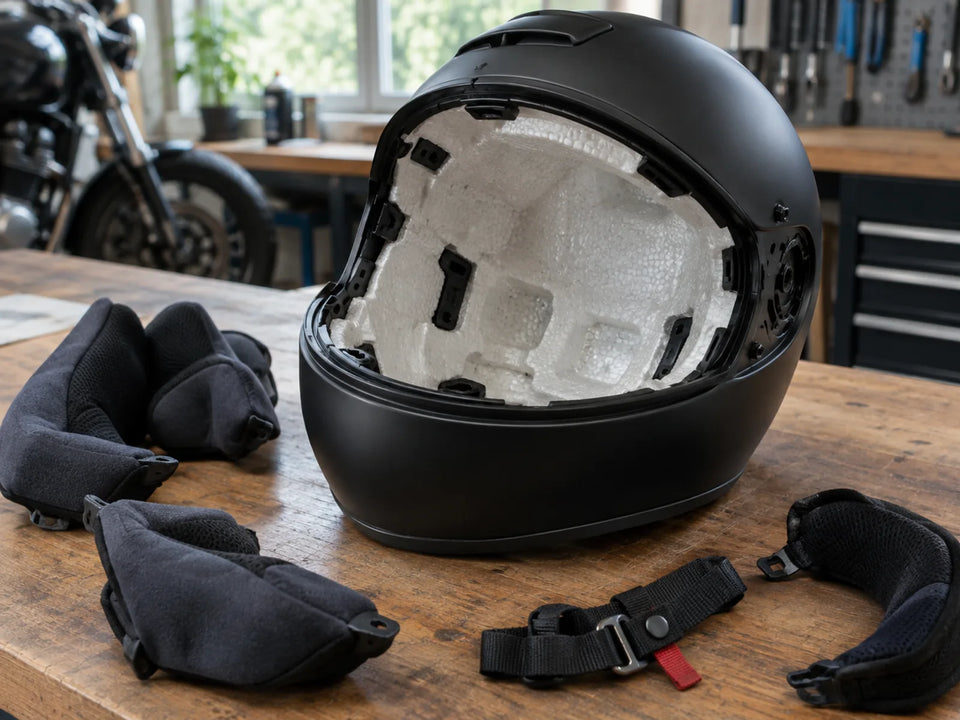
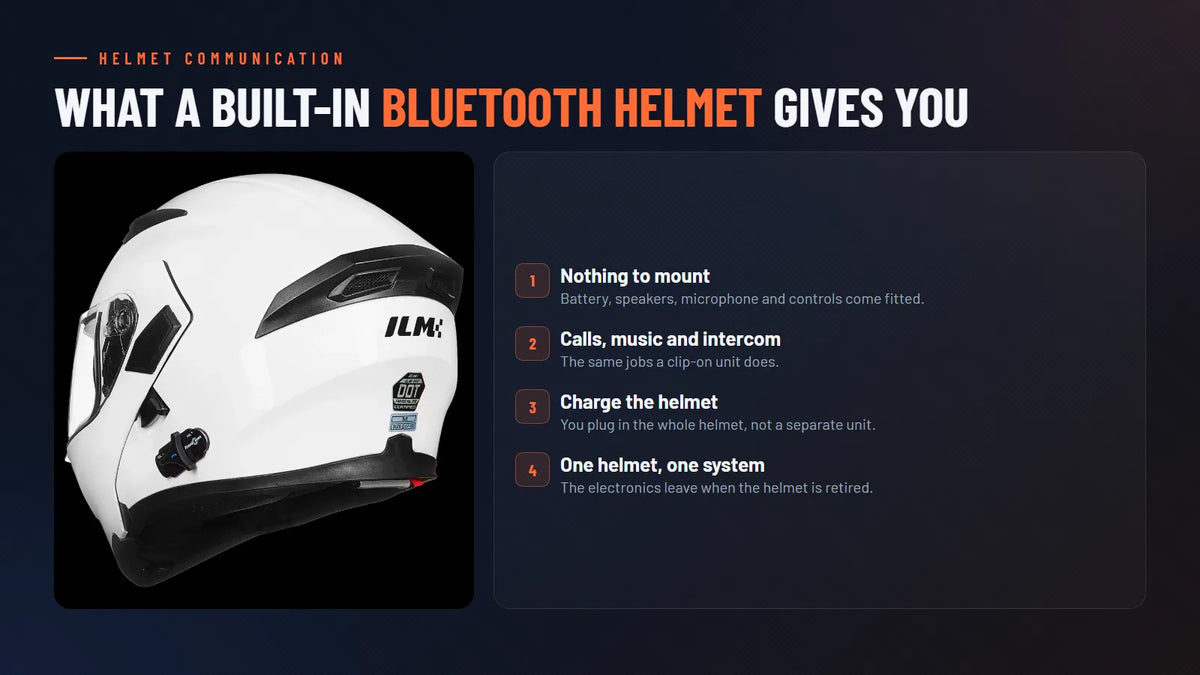
A built-in Bluetooth helmet is a motorcycle helmet sold with its communication system already fitted, so the battery, speakers, microphone and controls are part of the helmet itself.
Sena's Impulse shows how a fully built-in helmet works. It's a modular smart helmet with mesh and Bluetooth intercom, a built-in 1,300 mAh lithium polymer battery rated for up to 13 hours of mesh talk time and 20 hours of Bluetooth intercom, and a magnetic charging connector at the back that takes about 2.5 hours to charge. Sena sells it certified to DOT or to ECE 22.06, the UN Economic Commission for Europe helmet regulation, depending on the region.
A second kind is built for one helmet family. Sena's SRL3 is custom-designed to fit recesses inside three Shoei helmets (the Neotec 3, GT-Air 3 and J-Cruise 3), and Sena says it's virtually undetectable from outside once installed. It's rated for 10 hours of mesh talk time and 12 hours of Bluetooth intercom.
What is a clip-on helmet communicator?
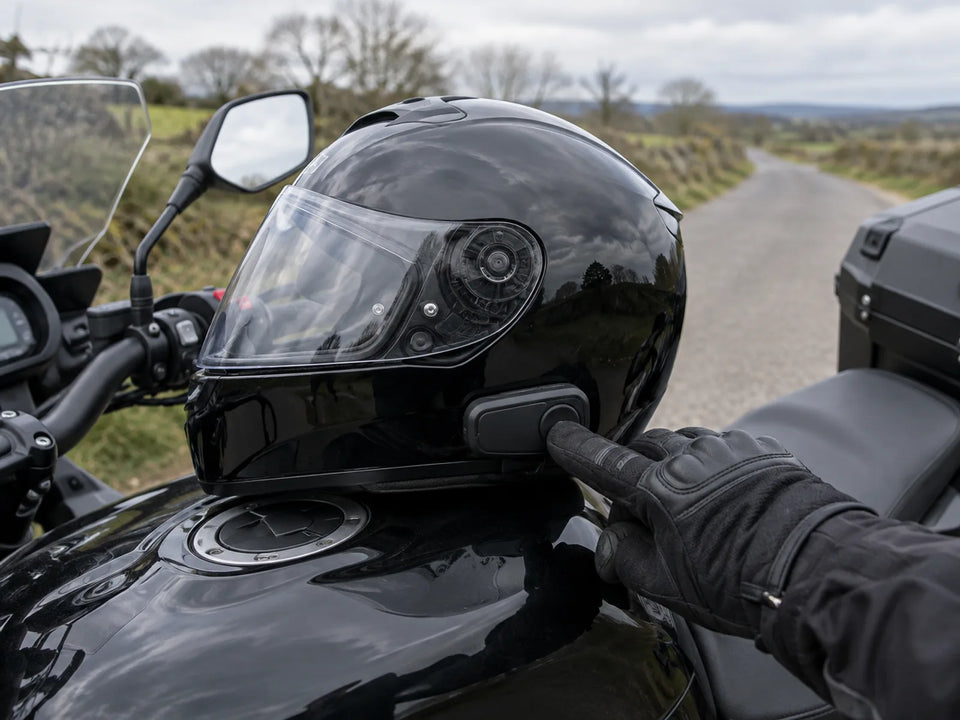
A clip-on helmet communicator is a self-contained Bluetooth unit that mounts on the outside of the shell, with thin speakers and a microphone wired into the helmet's interior.
Two current units show how they mount and run. Cardo's Packtalk Edge uses a magnetic mount, runs on Bluetooth 5.2, lists a 13-hour battery, and gives 2 hours of talk time from a 20-minute charge. Sena's 60S runs on Bluetooth 5.3, clicks onto a magnetic mount on either a helmet clamp or a glued surface plate, and is rated for 17 hours of mesh talk time and 24 hours of Bluetooth intercom, with a 1.5-hour charge.
The clip-on design has two practical edges. The unit comes off its mount, so you charge it indoors and leave the helmet on the bike, and Sena's 60S ships with two helmet clamps, so one unit switches between a street helmet and an adventure helmet.
How do built-in and clip-on setups compare?
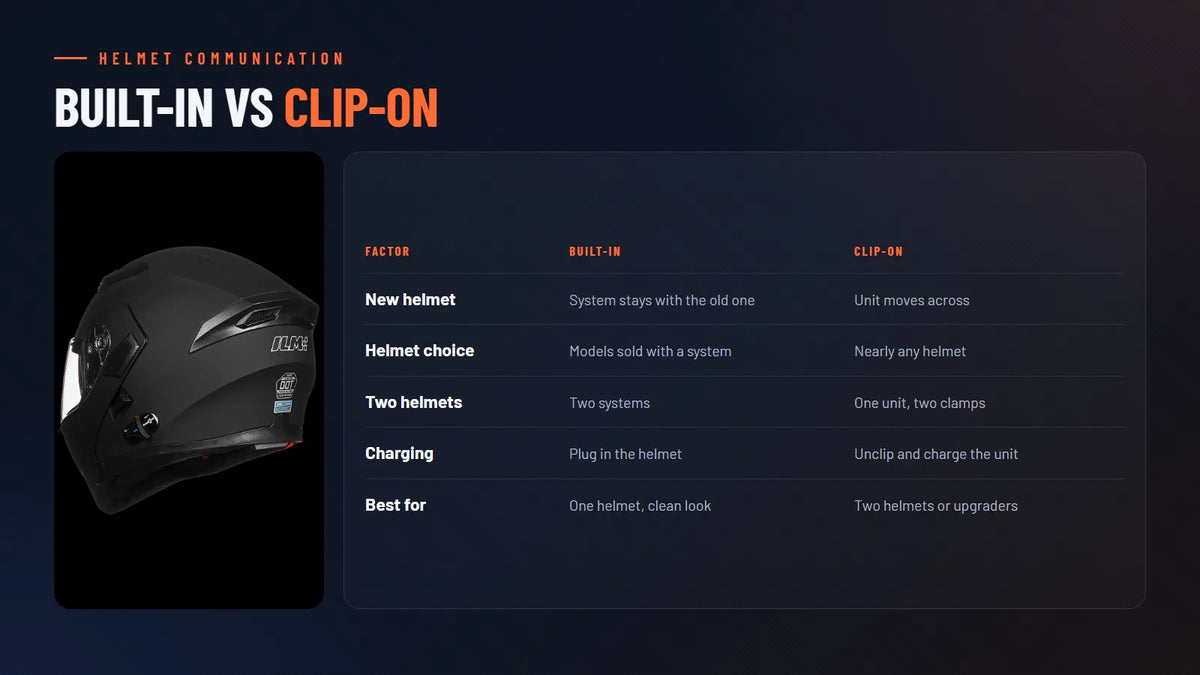
Built-in and clip-on setups compare on flexibility and tidiness: the clip-on unit wins every point that involves changing helmets, and the built-in helmet wins on a clean shell.
| Factor | Built-in Bluetooth helmet | Clip-on communicator |
|---|---|---|
| Changing helmets | The system stays with the old helmet | The unit moves to the new helmet |
| Helmet choice | Only helmets sold with a system, or made to take one | Nearly any helmet with room for speakers |
| Two helmets | Each helmet needs its own system | One unit, with a second clamp on the other helmet |
| Upgrades | A newer system means a newer helmet | Swap the unit and keep the helmet |
| Where the electronics sit | Inside the shell, nothing outside | A unit on the side of the shell, speakers and microphone inside |
| Charging | Plug in the whole helmet | Unclip the unit and charge it on its own |
| Cost | Included in the helmet's price | Bought once, reused across helmets |
| Best for | One helmet kept for its full life, clean look | Two helmets, or riders who upgrade often |
What do intercom range and Mesh vs Bluetooth mean?
Intercom range is the distance over which two riders' units stay connected, and makers quote it for open terrain, so expect less among hills and buildings. Bluetooth intercom and mesh intercom are the two ways units connect.
Bluetooth intercom links units by pairing them directly. Sena's 50S, for example, holds a four-way Bluetooth intercom conversation.
Mesh intercom links units as a network instead of a set of paired units. Sena says its mesh units share information and find the best route to pass the conversation from rider to rider, and Cardo calls its 2nd-generation Dynamic Mesh Communication (DMC) self-healing.
The published numbers, as of October 2026, look like this. Sena rates the 60S at 2 km (1.2 mi) in open terrain for both mesh and Bluetooth intercom, with up to 24 riders in a private Group Mesh and a virtually unlimited number on six Open Mesh channels. Cardo lists the Packtalk Edge at up to 1.6 km (1 mi) and up to 31 riders. Sena's overview pages also mention up to 5 miles (8 km) for Open Mesh while its spec sheets list 2 km, so plan around the spec-sheet figure.
What should you check before adding Bluetooth to a helmet?
Check the helmet's speaker pockets and mounting spot first, because those two decide whether a clip-on unit fits at all. These checks cover a helmet before any communicator goes on it.
- The helmet's speaker pockets need enough depth for the speakers; Sena's 60S speakers measure 40 mm (1.57 in) across and 8.6 mm (0.34 in) thick.
- The helmet needs a mounting spot, either a gap at the shell's lower edge for a clamp or a flat area for a glued plate, and Sena's 60S box includes both.
- A full-face helmet takes a small wired microphone inside the chin bar, while an open-face helmet needs a boom microphone that reaches in front of your mouth.
- A helmet worn with glasses puts frame arms and speakers in the same space over your ears, so place the speakers with your glasses on.
- A helmet communicator works best on the same system your riding partners use, since mesh links units of one brand.
Is it legal to use a helmet headset while riding?
Yes, in some states, but headset laws vary by state, so check your state's vehicle code before you ride with one. Florida Statutes section 316.304 (2026) bans wearing a headset while operating a vehicle, but exempts a motorcyclist using a headset installed in a helmet and worn so the speakers don't touch the ears directly, leaving the rider able to hear surrounding sounds.
California Vehicle Code section 27400 bans wearing a headset covering, earplugs in, or earphones covering, resting on or inserted in both ears while operating a motor vehicle. It exempts earplugs or molds designed to cut harmful noise that still let you hear sirens and horns, and it doesn't mention helmet speakers.
Phone laws matter too. The Governors Highway Safety Association (GHSA) counts 33 states plus Washington, D.C., that ban hand-held phone use for all drivers, in its state laws overview last updated in October 2025.
Do speakers affect helmet fit or noise?
Yes, speakers take up room in the helmet's ear pockets, so a helmet that fit well before gets tighter over your ears once they're in. Run the helmet fit tests again with the speakers installed. Speakers don't block wind noise either, and turning the volume up to talk over the wind adds to the sound reaching your ears, so keep it only as loud as you need.
Where can you see a Bluetooth modular helmet?
AtomBiker, a US online store for motorcycle helmets, jackets, gloves, boots and pants, sells a Bluetooth modular flip-up helmet with its system built in. Its product photos show up to 500 meters (1,640 feet) of intercom range for 2 to 3 riders and 8 hours of intercom talk time, and its description lists rider-to-rider intercom with the ILM 953 Bluetooth helmet. Riders in a group running Cardo or Sena units should ask the store about compatibility first.
Frequently asked questions
Can a passenger talk to the rider through a helmet intercom?
Yes, a rider and passenger talk through the intercom when both helmets have a unit and the two are paired, the same way two riders connect. Check that a built-in helmet's system pairs with your passenger's unit before you buy, since some built-in systems list intercom only with their own models.
Do Cardo and Sena intercoms work together?
Yes, over Bluetooth intercom, since Cardo says the Packtalk Edge connects with other major brands. Mesh stays within each maker's own system, and Sena's 60S page offers Bluetooth intercom for riders who don't have mesh-enabled Sena devices.
Are helmet communicators waterproof?
Yes, the Cardo Packtalk Edge carries an IP67 rating and the Sena 60S an IPX7 rating, both ratings for water resistance. Rain isn't a reason to leave either unit at home.
Can you listen to music while using the intercom?
Yes, Sena says the 60S lets you play music while you take part in intercom conversations. Cardo says the Packtalk Edge shares music with another unit, so a rider and passenger hear the same track.
Is a modular helmet better for a Bluetooth setup?
No, any full-face, modular or open-face helmet with room for speakers takes a communicator, though a modular lets you talk face to face at a stop with the chin bar up. The trade-offs of that design are laid out in our guide to modular flip-up helmet pros and cons.
Should you choose the helmet or the communicator first?
Choose the helmet first, because fit and protection matter more than any communicator, then pick a unit that fits its speaker pockets. The helmet decision itself starts with our guide on how to choose a motorcycle helmet.
Shop this guide
Start with the right questions.
Compare construction, fit and features. Open each product for its available sizes, current price and stated certifications.