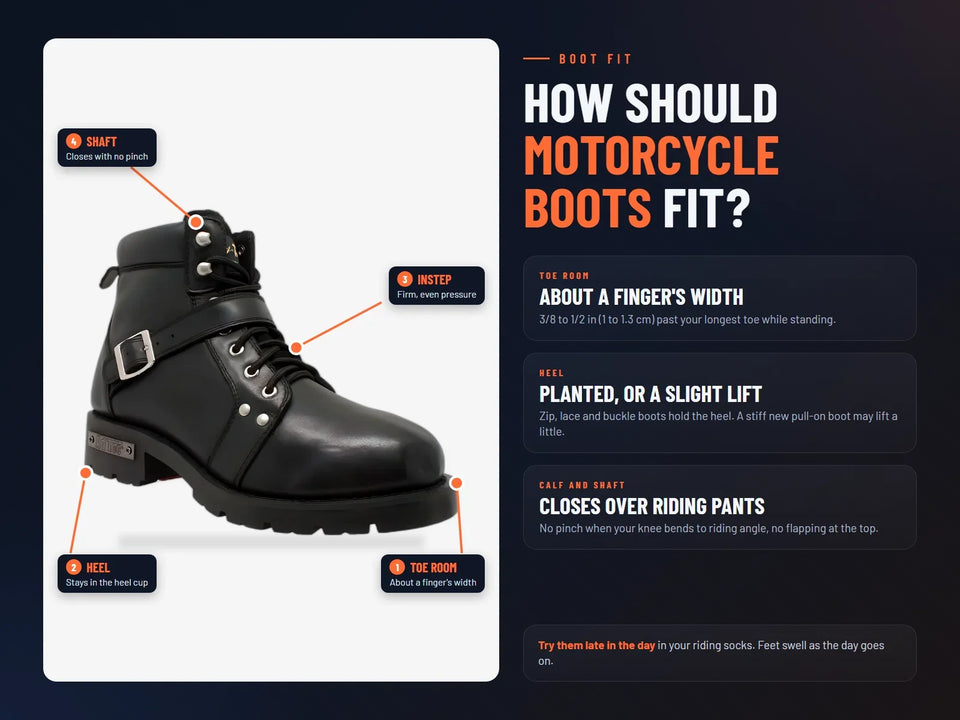

Motorcycle boots should fit snug at the heel, instep and ankle, with about a finger's width (3/8-1/2 in, or 1-1.3 cm) between your longest toe and the front of the boot while standing. The heel stays put or lifts only slightly, the shaft closes over your calf without pinching, and any ankle cups sit on your ankle bones.
That toe allowance is the American Orthopaedic Foot & Ankle Society's shoe-fit guideline, and an inch or more of empty space means the boot is too long. Heel lift is where sources split: Harley-Davidson reads a lifting heel as a loose boot, while a bootmaker that builds engineer boots accepts a slight lift in a stiff new pull-on boot. Calf fit gets checked at the top of the shaft over riding socks, a wrong size shows first at the toes and heel, and break-in softens the leather and adds a little width but almost no length.
How should motorcycle boots fit?
Motorcycle boots should hold your heel, instep and ankle firmly while your toes stay free to move, and that fit has to work seated on the bike as well as standing in a store. Feet swell during the day, so the American Academy of Orthopaedic Surgeons (AAOS) advises trying on new shoes late in the day, and the same timing suits riding boots.
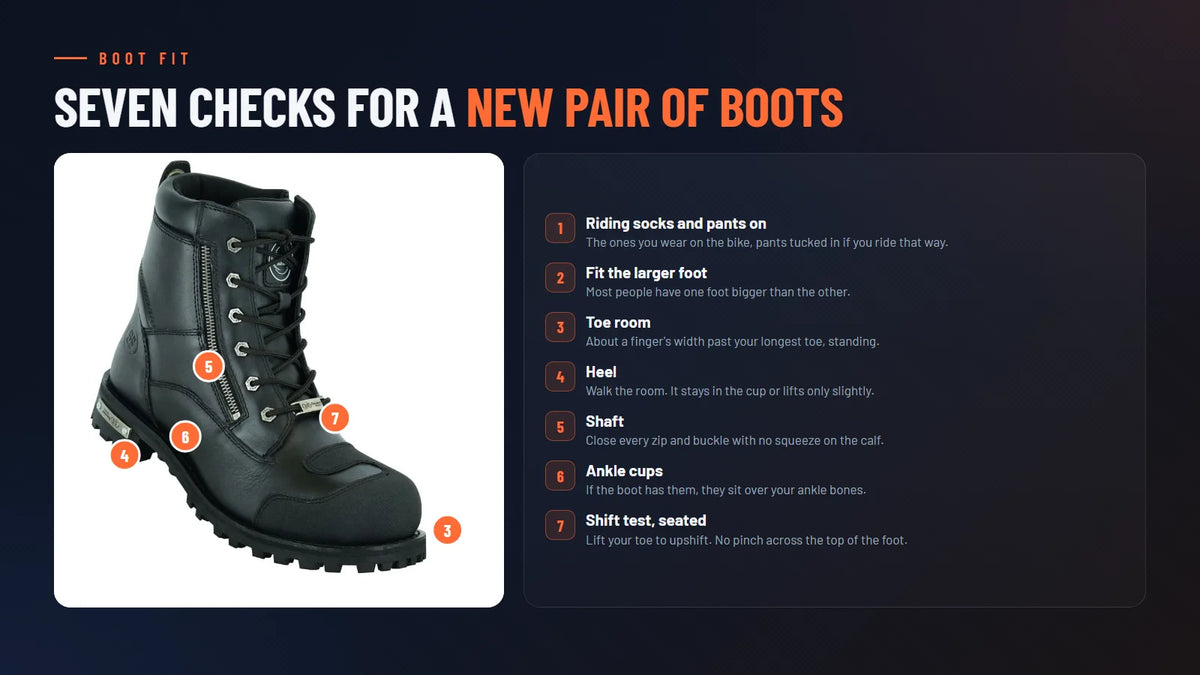
Check a new pair of riding boots in this order, at home on a clean floor or in the store.
- Put on the riding socks you wear on the bike, plus the riding pants you plan to tuck inside the boot shaft.
- Pull on both boots and fit the boot to your larger foot, since most people have one foot bigger than the other.
- Stand with your weight on the boot and check for about a finger's width of space past your longest toe.
- Walk across the room and watch the boot heel, which stays in the heel cup or lifts only slightly.
- Close every boot zip, buckle and strap, and check that the shaft closes without squeezing your calf.
- Press on the boot's ankle cups, if it has them, and check that they sit over your ankle bones.
- Sit in a riding position, lift your toe as if to upshift and press down as if standing on a footpeg, and check that the boot doesn't pinch the top of your foot.
A boot that passes standing and fails seated is the wrong boot for riding. Common Tread, the editorial site of RevZilla and Cycle Gear, gives the same advice in its boot sizing guide (2019): a boot that gets in the way of the controls needs swapping for a different pair.
How much toe room do motorcycle boots need?
Motorcycle boots need about a finger's width of toe room: 3/8-1/2 in (1-1.3 cm) of space between your longest toe and the end of the boot while you stand. That range is the shoe-fit guideline of the American Orthopaedic Foot & Ankle Society (AOFAS), and the AAOS footwear guide gives 1/2 in.
Toes that touch the front are a fail, even in a stiff boot that "will break in." Harley-Davidson's boot advice says your toes need some wiggle room and shouldn't hit the front of the boot. Riding adds load here, because hard braking pushes your foot forward inside the boot.
Too much room fails too. Nick's Boots, a US work-boot maker, says an inch (2.5 cm) or more of space ahead of your toes means the boot is too big, and a long, empty toe box puts extra leather between your toe and the shift lever.
Check toe room two ways. Stand and press your thumb on the toe box over your longest toe, or pull out the insole and stand on it, where your longest toe ends about a finger's width short of the tip. The toe box needs height as well, so wiggle your toes upward and feel for pressure on the nails.
How much heel lift is normal in new boots?
Very little heel lift is normal in new motorcycle boots: a zip, lace or buckle riding boot keeps the heel planted, and a stiff new pull-on leather boot lifts slightly at most, never far enough for the heel to leave the heel cup. Sources split on the pull-on case, since Harley-Davidson's boot guide says a heel that lifts or slides up and down probably means a loose boot, while Nick's Boots says a new engineer boot's heel just starts to lift out of the heel cup and no more. The difference comes from how each boot grips the foot. Laces and buckles clamp the instep, while a pull-on boot relies on its shape alone, and Nick's Boots says it needs enough tension across the top of the foot to keep you from slipping out.
Extra lift costs you on the bike. A heel that rides up lets the ankle protection slide off your ankle bone, and it rubs blisters on a long day.
Work through the heel-lift fixes in order. Fasten the buckles from the bottom up, as Harley-Davidson advises, then try a thicker riding sock, which Common Tread suggests for a gap at the heel. A heel that still lifts on every step needs a smaller size or a narrower boot.
How should the calf and shaft fit?
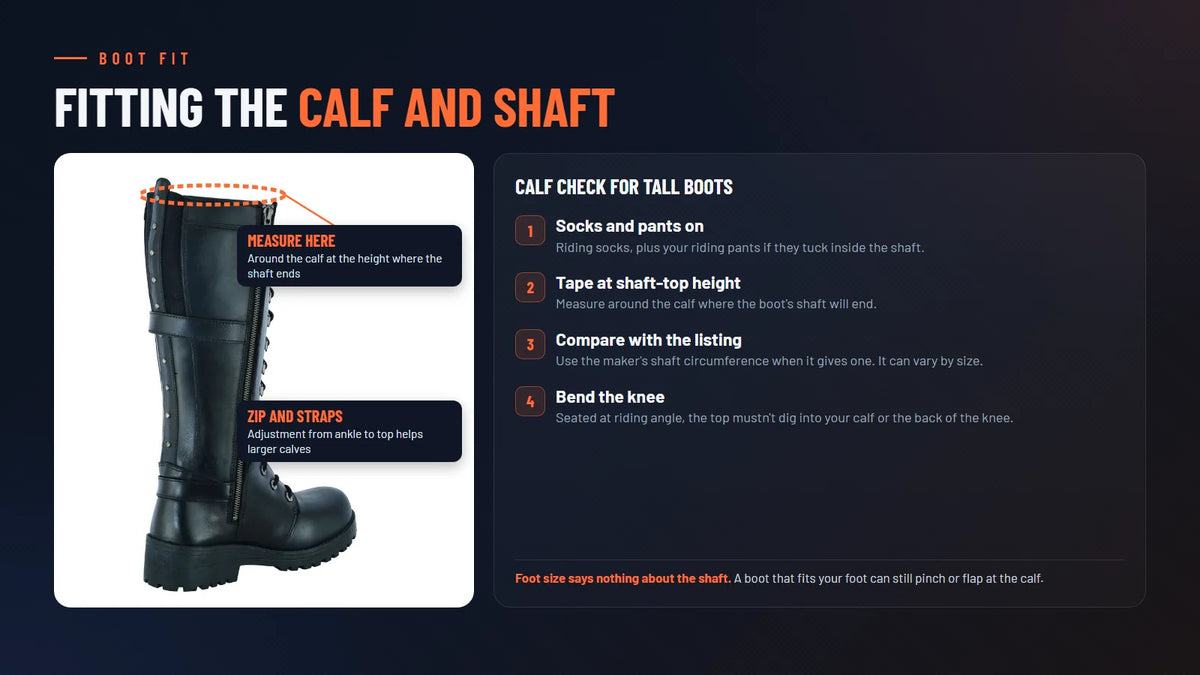
The calf and shaft of a motorcycle boot should close fully around your leg, over your riding pants when they tuck in, without pinching as your knee bends and without flopping loose at the top. Shaft fit matters most on tall boots, because the length and width of the foot say nothing about the size of the shaft.
Measure your calf the way UK bootmaker Alt-Berg does: around the calf, with socks on, at the height where the boot's shaft ends, and with your riding pants on if you wear them inside the boot. Compare that number with the shaft circumference when the maker lists one. Frye, for example, lists a 14 in (35.6 cm) shaft circumference for its women's 12R harness boot and notes that it varies by size.
Riders with larger calves need adjustment built in. Common Tread advises boots that adjust from the ankle to the top, since a fixed shaft that doesn't fit leaves little to change, and Alt-Berg offers a made-to-measure service for unusually wide or narrow calves.
Sit with your knee bent to riding angle as the last check, and make sure the top of a tall shaft doesn't dig into your calf or the back of your knee. Shaft height itself depends on the boot type, with ankle-high riding shoes at one end and race boots that stop just below the knee at the other, as compared in motorcycle boot types.
What are the signs boots are too small or too big?
The signs of a wrong boot size show up at six fit points: toes, foot width, instep, heel, shaft and the shift lever. Toe and heel problems call for a different size, while a shaft that won't close calls for a different model.
The table lists the too-small and too-big signs at each fit point, next to what a correct boot fit feels like.
| Fit point | Too small | Too big | Right fit |
|---|---|---|---|
| Toes | Toes touch the front when you stand or brake | An inch (2.5 cm) or more of space ahead of the toes | About a finger's width of space while standing |
| Foot width | Pressure on the little toe or the big-toe joint | Foot slides side to side on the footpeg | Ball of the foot sits in the widest part of the boot |
| Instep | Top of the foot aches after a short ride | Foot slides forward on every step | Even, firm pressure across the top of the foot |
| Heel | Heel counter digs into the back of the heel | Heel rides up and down on every step | Heel stays in the cup, or lifts slightly in a new pull-on boot |
| Shaft | Zip or buckle won't close over riding pants | Shaft gaps and flaps in the wind | Closes fully with no pinch when the knee bends |
| Shift lever | Toe box pinches when you lift your toe to shift | Toe box feels vague and slow under the lever | Toe slides under the lever and shifts cleanly |
A mixed result, such as tight toes with a loose heel, points to a boot shape that doesn't match your foot. The AOFAS advises matching the shape of the shoe to the shape of the foot, so try a different model before a different size.
How does break-in change boot fit?
Break-in changes boot fit by softening the leather and molding the footbed to your foot, and it adds a little width but almost no length. Nick's Boots says stretching gets you no more than a half size in length or one size in width, and RaceLeathers, a UK gear retailer, notes that leather riding boots stretch more than synthetic ones.
That makes length the number to get right on day one. A full-grain leather boot that feels snug across the ball of the foot loosens slightly with wear, but a boot that crushes your toes stays too short, and the AOFAS advises against buying shoes in the hope that they'll stretch. A heel that rides up on every step won't fix itself either.
Ease into a new pair. Red Wing's break-in advice is to wear new leather boots indoors for a few hours at a time before moving to all-day wear, and a first long ride deserves the same patience.
Is your boot size the same as your shoe size?
No, not always: your US shoe size is the starting point, and your measured foot length is the check. AtomBiker, a US online store for motorcycle helmets, jackets, gloves, boots and pants, starts boot sizing from your standard US shoe size and lists the matching EU size and foot length on its Sizing Guide, with two rules: size up for half sizes or wide feet, and try boots on with riding socks.
European riding boots are sold by EU size, and boot maker TCX tells buyers to measure their feet instead of relying on their usual shoe size, since one EU size can match more than one US size. Common Tread adds that once you know your size in one pair of riding boots, it stays roughly the same across brands. The heel-against-the-wall foot measurement is in How to Take Body Measurements for Motorcycle Gear.
Can you wear boots over or under riding pants?
Yes, riding pants work over or under motorcycle boots, and each choice changes the boot fit you need. Pants worn over the boot need a leg wide enough to cover the shaft, and they keep rain from running down your shin into the boot. Pants tucked inside need extra shaft room, which is why the calf check happens with your riding pants on.
Where can you find motorcycle boots in your size?
AtomBiker lists the sizes for each boot on its product page in the motorcycle boots collection, and some of its leather boots come in W (wide) widths as well as M (medium). The store's 30-day return window covers unused, unworn items with the tags attached, so run the fit check indoors on a clean floor before you ride in a new pair.
Frequently asked questions
Should motorcycle boots be tight or loose?
Motorcycle boots should be snug, not tight: firm at the heel, instep and ankle, with room to wiggle your toes. Nick's Boots describes the right new-boot feel as snug but not tight or painful. A loose boot lets your foot slide and moves any ankle protection off the ankle bone.
What socks should you wear with motorcycle boots?
Wear moisture-wicking riding socks in the thickness you actually ride in, and try boots on with them. Common Tread advises against thin cotton socks in riding boots, and a thicker sock also takes up a little space in a boot that's slightly loose at the heel.
Should you size up for motorcycle boots?
No, buy the size that matches your foot, and size up only for half sizes or wide feet, the two cases the Sizing Guide names. Sportsbikeshop, a UK gear retailer, notes that Italian boots tend to run narrower than other makes, so riders with wide feet check the width before the size.
Are new motorcycle boots supposed to hurt?
No, new motorcycle boots feel stiff but don't hurt when they fit. Common Tread notes that boots might need time to break in but should feel comfortable on the bike from the start. Pain at the toes, sides or instep means the wrong size or shape, not a boot that needs more miles.
Why does one boot fit tighter than the other?
One boot fits tighter because most people have one foot larger than the other, according to the AAOS. Fit both boots to the larger foot, and use a thicker sock on the smaller side when the looser boot lets your heel lift.
Can you ride in boots that are a size too big?
No, a boot a size too big lets your foot slide inside it, shifts the ankle protection off your ankle bones and makes the boot easier to lose in a crash.
Shop this guide
Start with the right questions.
Compare construction, fit and features. Open each product for its available sizes, current price and stated certifications.


Motorcycle Boots