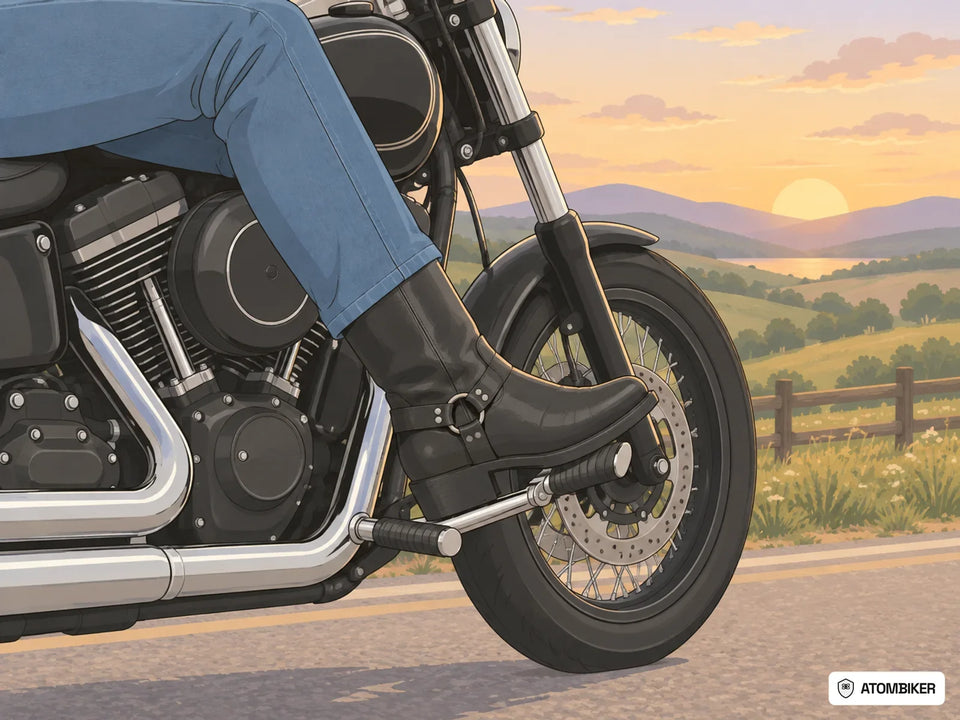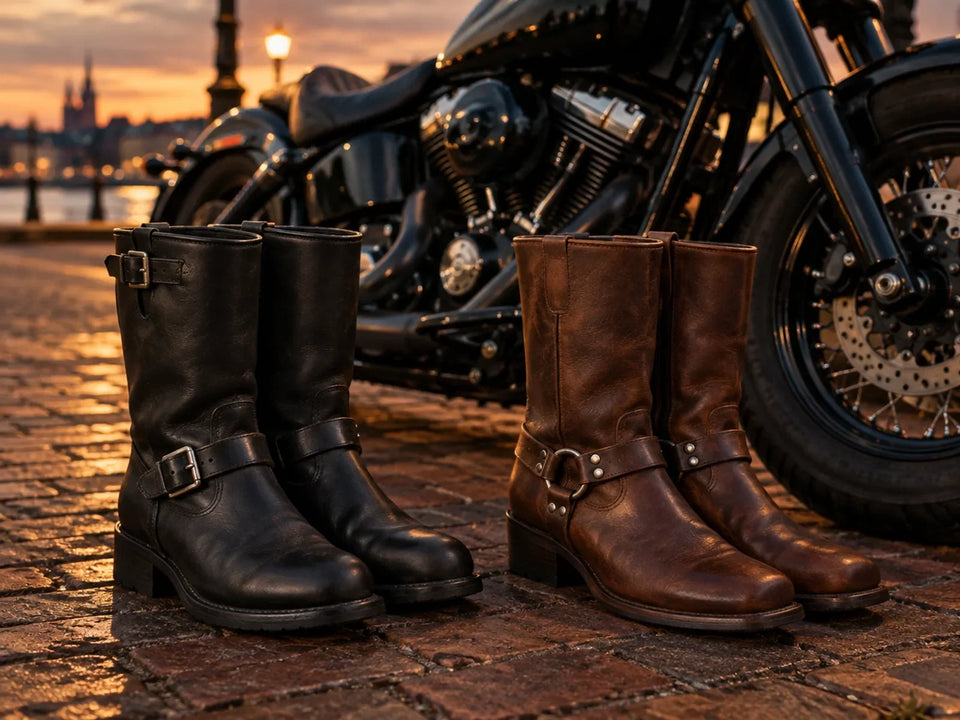

Engineer boots and harness boots are pull-on leather motorcycle boots without laces. An engineer boot has buckled straps across the instep and at the top of the shaft, and a harness boot has fixed straps riveted to an ankle ring. For cruiser riding, the engineer boot's adjustable straps give the firmer fit.
Engineer boots came from US work-boot makers Wesco and Chippewa in the late 1930s, while harness boots trace to Frye, which ties its design to Civil War cavalry boots. The engineer's straps adjust and the harness boot's ring and straps don't, and that difference decides which one holds your foot better on a cruiser. Neither style usually carries ankle armor or an EN 13634 rating, so both protect less than a modern riding boot.
What is the difference between engineer and harness boots?
The difference between engineer and harness boots is the strap system: an engineer boot tightens with two buckled straps, one across the instep and one at the top of the shaft, while a harness boot carries leather straps riveted to a metal ring at the ankle that don't adjust. Standard & Strange, a US heritage boot retailer, adds the second visible difference: engineer boots usually have a rounded toe, and harness boots a square one.
Everything else overlaps. Both styles pull on with no laces, eyelets or tongue, both use heavy leather over a low heel, and both are sold today as motorcycle boots. That laceless build is why riders took to them, since the American Society of Mechanical Engineers (ASME), in its history of the engineer boot, notes there are no laces to get caught in the drive belt.
What are engineer boots?
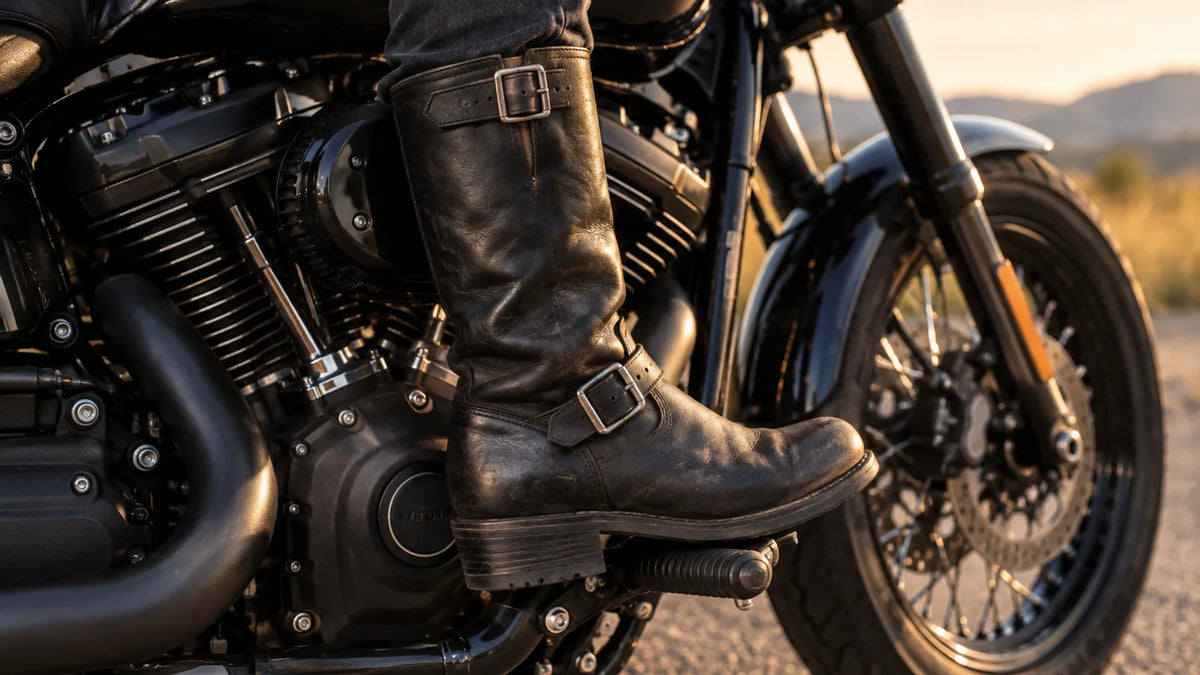
Engineer boots are tall pull-on leather work boots with a stovepipe shaft, a buckled strap across the instep and a second buckled strap at the top of the shaft that cinches it around your calf. ASME's history (2015) puts the shaft anywhere between 7 and 17 in (18-43 cm) up the leg, and Red Wing London's history of the style (2019) calls the 9-11 in (23-28 cm) medium height the most traditional.
The first engineer boots came from Wesco and Chippewa between 1937 and 1939, according to Standard & Strange. ASME credits Chippewa in the late 1930s and dates Wesco's version, the ancestor of its Boss boot, to 1939.
Work, not riding, shaped the design. Wesco told ASME that shipyard welders needed boots they could kick off quickly if sparks got inside, and ASME notes that customers in some trades cared more about how fast the boots came off than how snugly they fit. Makers still vary the details, with ASME listing heel height, sole material, toe shape and steel reinforcement as choices that differ by model.
What are harness boots?
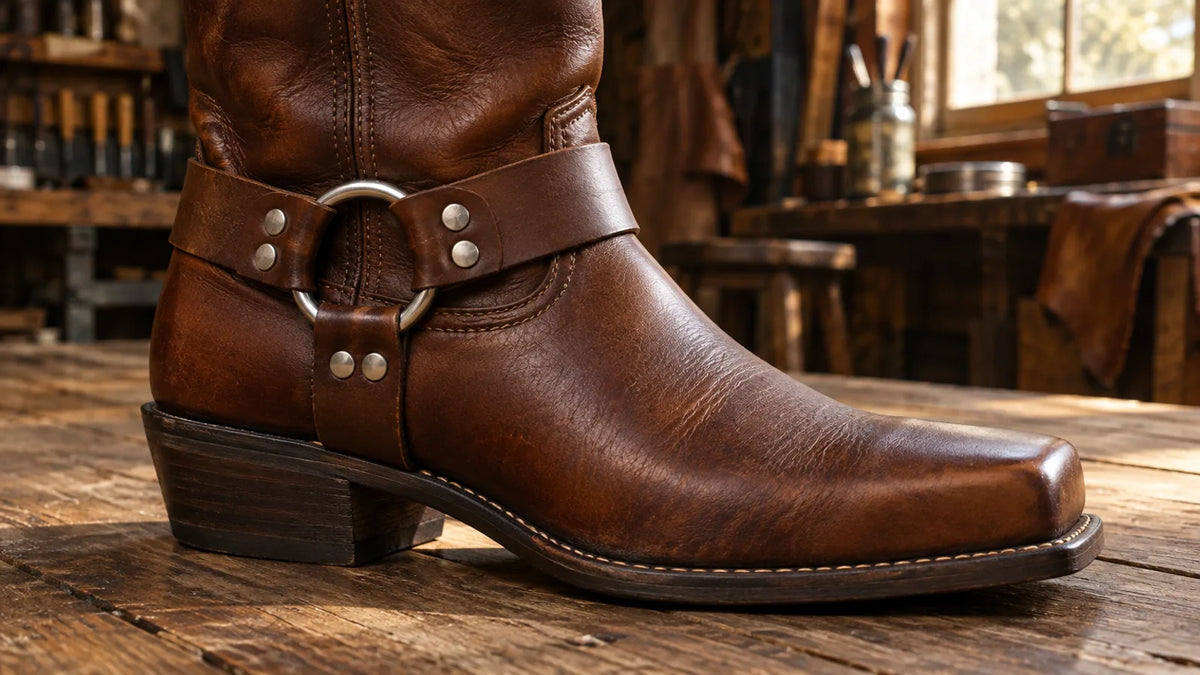
Harness boots are pull-on leather boots with leather straps riveted to a metal O-ring at the ankle in place of buckles, usually on a square toe. Harley-Davidson describes its Rory harness boot as having front, back and bottom straps riveted to an O-ring, and its Hustin harness boot as having a front and back cross-strap with an attached O-ring.
Frye, the bootmaker founded in Marlborough, Massachusetts, in 1863, says its Harness boot was inspired by Civil War cavalry soldiers, and ASME notes the U.S. Cavalry adopted the style. Sources disagree on the date: ASME places Frye's Harness boot around 1860, while Frye's own heritage timeline lists it after its 1960s entries.
Riding and fashion versions look alike, so read the specs. Harley-Davidson sells its Hustin and Rory as 11 in (28 cm) motorcycle boots, while Frye's women's 12R harness boot lists a manmade sole and no riding features.
How do engineer and harness boots compare?
Engineer and harness boots match on leather and closure, and they split on adjustable fit, toe shape and history. The table sets the two classic biker boot styles side by side.
| Feature | Engineer boots | Harness boots |
|---|---|---|
| Closure | Pull-on, no laces | Pull-on, no laces |
| Straps | Buckled straps across the instep and at the top of the shaft | Leather straps riveted to a metal O-ring at the ankle |
| Adjustable fit | Yes, both straps tighten | No, the ring and straps are fixed |
| Toe | Usually rounded | Usually square |
| Shaft height | 7-17 in (18-43 cm); 9-11 in (23-28 cm) is traditional | Varies by model; Harley-Davidson's Hustin and Rory are 11 in (28 cm) |
| Origin | US work boot from Wesco and Chippewa, 1937-1939 | Frye design inspired by Civil War cavalry boots |
| Riding strength | Straps snug the boot at the instep and calf | Goes on in seconds with nothing to fasten |
| Riding weakness | Built to come off fast, so it's loose unless strapped tight | Fit depends on the instep alone, with no way to take up slack |
| Ankle armor | Not standard; check the product page | Not standard; check the product page |
Which style rides better on a cruiser?
The engineer boot rides better on a cruiser, because its two buckled straps snug the boot around your instep and calf, and a boot that stays tight on your foot keeps its leather and any ankle reinforcement where they protect you. A harness boot holds your foot only as well as its instep fits, since Standard & Strange notes that a harness boot's ring and straps can't be adjusted for fit.
Strap the engineer boot properly to get that advantage. A boot designed to be kicked off quickly rides safely only with both straps pulled snug, and the top strap also closes the shaft so wind and rain don't funnel down your shin. The tall shaft is the engineer's other plus, and ASME credits it with insulating the leg from engine heat.
The harness boot suits riders whose instep fits it closely and who want a boot that goes on with no buckling. For both styles, the heel, sole and shift pad decide more about cruiser riding than the straps do, so check those on the product page too.
Do classic biker boots protect like modern riding boots?
No, classic engineer and harness boots protect less than modern riding boots, because they're built without the ankle armor, stiffened sole and EN 13634:2017 testing that a certified riding boot carries. EN 13634:2017 is the European standard for protective motorcycle footwear. Classic boots do some jobs well. Thick leather resists abrasion, a tall shaft covers the shin, and there are no laces to snag, which Cycle World (2016) lists as a reason to avoid laced boots on the street. What they miss is the hidden structure: firm cups over the ankle bones, a sole stiff enough to resist crushing, and a closure designed to keep the boot on in a crash.
Riding versions close part of the gap with oil-resistant soles and hidden reinforcements, so check the product page for ankle protection and an EN 13634 label. No boot prevents every injury, and the gaps everyday boots leave on a motorcycle are laid out in our guide on whether you really need motorcycle boots.
Do engineer boots need breaking in?
Yes, engineer boots need breaking in, because the thick leather starts stiff and softens with wear while the footbed molds to your foot, as Nick's Boots, a US work-boot maker, describes. Wear them indoors for a few hours at a time before a long ride, which is Red Wing's advice for new leather boots, and judge the fit once they've softened with our motorcycle boot fit guide.
Can you wear harness boots off the bike all day?
Yes, a broken-in harness boot works as an all-day boot, which is why fashion brands such as Frye sell the style alongside motorcycle brands. It's still a heavy pull-on boot, so riders who walk miles on a ride day pick riding shoes or touring boots instead, both covered in our guide to motorcycle boot types.
Where can you see engineer boots?
AtomBiker, a US online store for motorcycle helmets, jackets, gloves, boots and pants, sells the Shadowstep 13-inch engineer boots, made of full-grain oiled leather with adjustable collar and side ankle straps and an oil-resistant outsole. The product page lists a plain soft toe and no ankle armor or EN 13634 rating, so it's a classic engineer boot for style and abrasion, not an armored riding boot.
Frequently asked questions
Why do bikers wear engineer boots?
Bikers wear engineer boots because the laceless pull-on design has nothing to catch on the drive belt and the tall leather shaft shields the leg from engine heat, according to ASME. Standard & Strange cites 1940 Sears ad copy calling them popular with motorcyclists, and Marlon Brando wore them as a motorcycle gang leader in The Wild One (1953).
Why are they called engineer boots?
The engineer boot's name has two competing explanations. Red Wing says the boot was designed in 1936 for engineers working on America's railroads, while Standard & Strange calls the train story a myth and reads the 1940 Sears ad copy as tying the name to surveying and engineering work.
Do engineer boots have steel toes?
Yes, some engineer boots have steel toes and others don't. Red Wing's 2268 is a steel-toe engineer boot, while AtomBiker's Shadowstep lists a plain soft toe. A steel toe is a jobsite feature for falling objects, not a motorcycle crash rating.
Can you tuck jeans into engineer boots?
Yes, jeans tuck into engineer boots, because the stovepipe shaft is wide enough for the denim and the buckled top strap tightens the shaft around it. Boot-cut jeans worn over the shaft work too and keep rain from running into the boot.
Do the ring and straps on harness boots do anything?
No, the ring and straps on a harness boot don't tighten the fit, since they're riveted in place, as on Harley-Davidson's Rory. Standard & Strange notes they can't be adjusted, so they work as a styling detail carried over from the cavalry-inspired original.
Shop this guide
Start with the right questions.
Compare construction, fit and features. Open each product for its available sizes, current price and stated certifications.


Motorcycle Boots