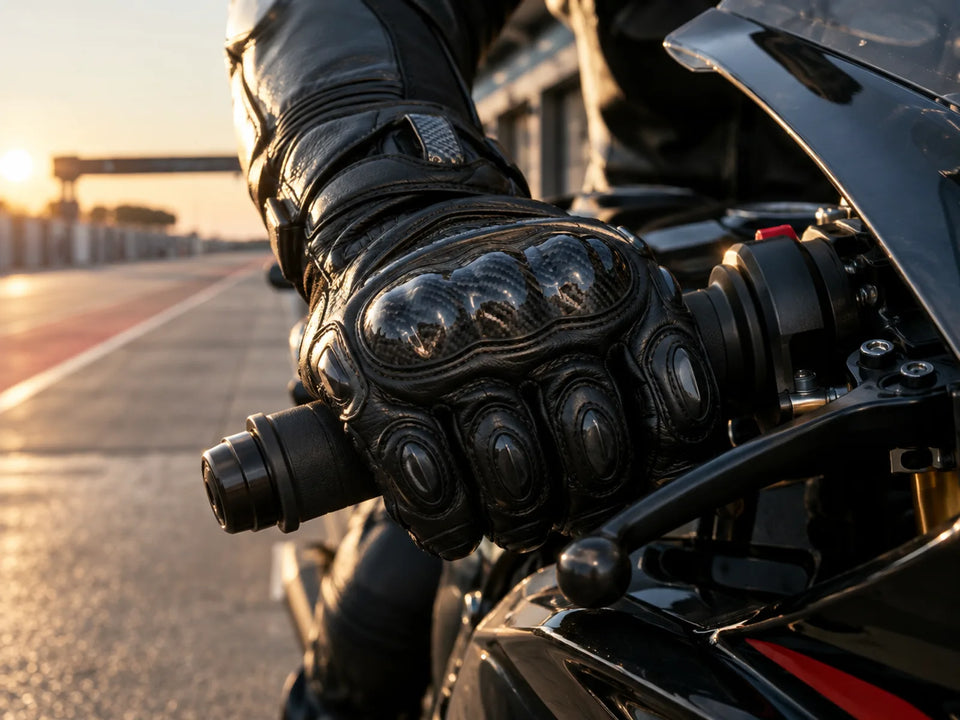

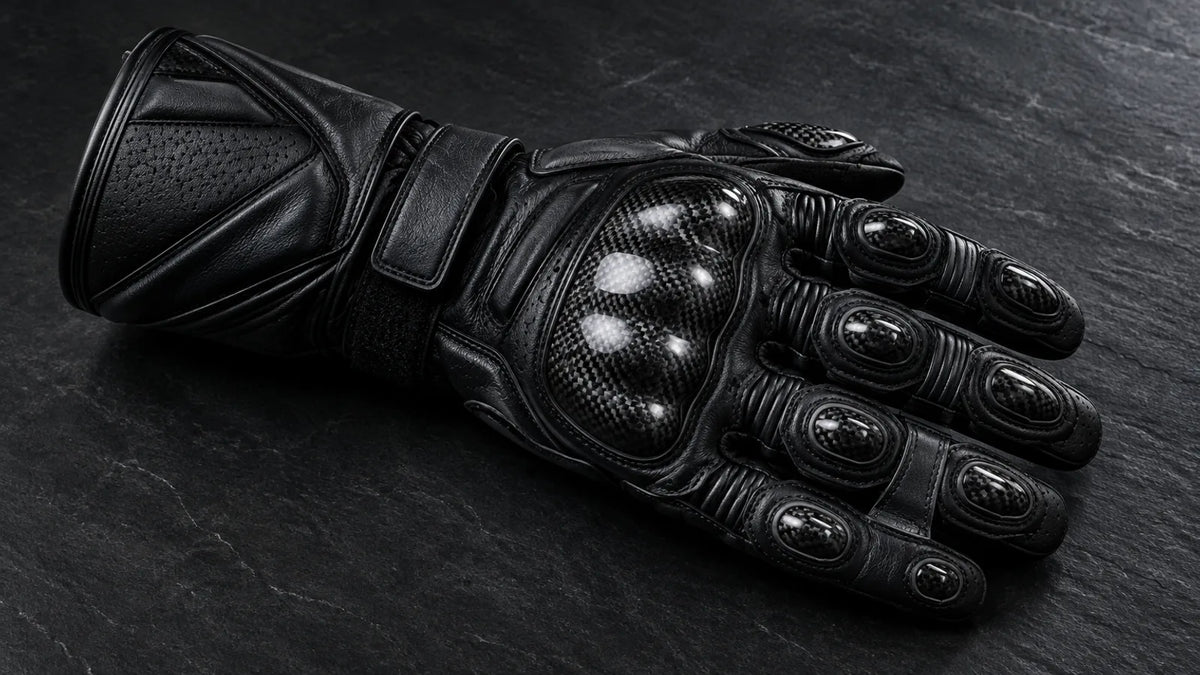
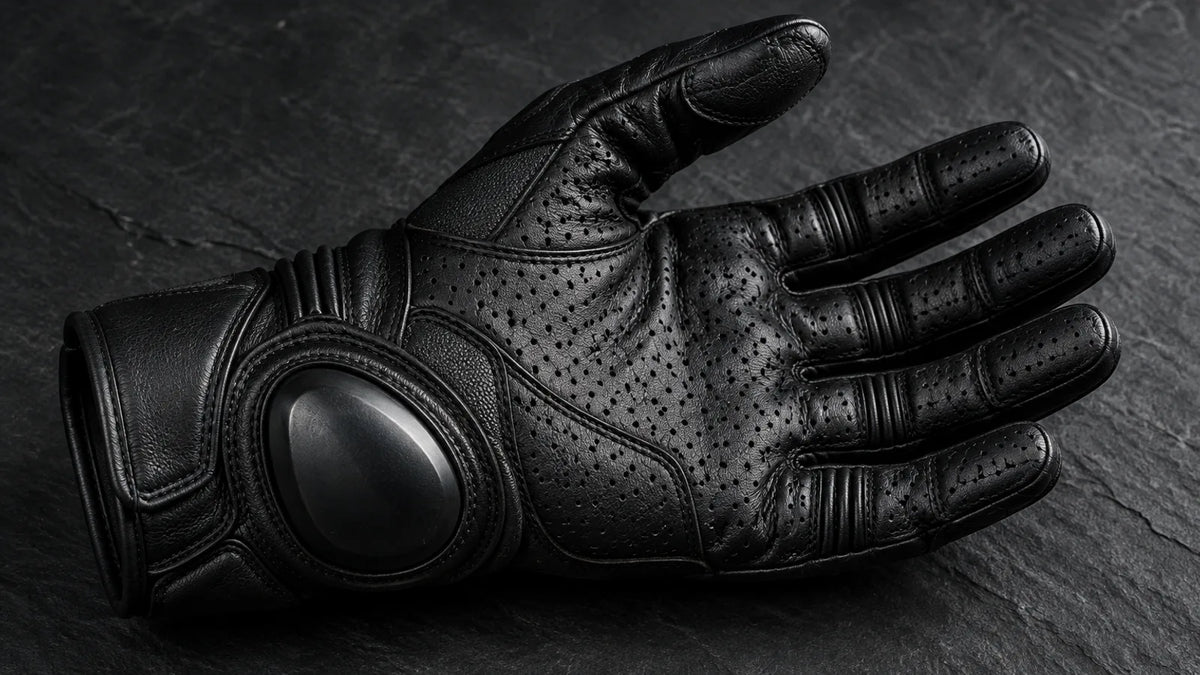
Motorcycle racing gloves are full-gauntlet leather gloves built for track speeds, and four armor features set them apart: a scaphoid slider on the heel of the palm, a finger bridge that stops the little finger bending back, a hard knuckle shell and finger sliders. Each one targets a specific hand injury in a high-speed slide.
The scaphoid is a small wrist bone that breaks in falls onto an outstretched hand and often heals poorly because of its weak blood supply, according to the American Academy of Orthopaedic Surgeons (AAOS). Knuckle shells and finger sliders spread impacts and skid across the asphalt, and a lab knuckle test shows whether they work. Street riders gain from the same features without needing a full race glove. Track-day organizers ask for gauntlets that leave no skin showing, and a race glove fits snug in a tuck, sized around the knuckles.
What makes a glove a racing glove?
A racing glove is a full-gauntlet leather glove that adds hard sliding and impact armor to the palm, knuckles and fingers, cut for the speeds and lean angles of track riding. Alpinestars' 2026 track-day checklist names the core features as a long gauntlet covering the sleeve, full-grain leather, hard knuckles and palm sliders.
Racing gloves share seven features, listed with the most race-specific first.
- A racing glove's scaphoid slider is a hard, low-friction pad on the heel of the palm that lets the hand skid along the road instead of gripping it.
- A racing glove's finger bridge joins the little finger to the ring finger.
- A racing glove's finger sliders are hard panels over the finger joints.
- A racing glove's knuckle shell is a hard cap of carbon fiber, titanium or molded plastic over the knuckles.
- A racing glove's full gauntlet closes over the suit sleeve with a wrist strap and often a second closure at the cuff.
- A racing glove's palm is often kangaroo leather, as on Knox's Handroid with its 0.8 mm kangaroo palm.
- A racing glove's fingers are pre-curved to the shape of a hand on the grip, so the leather doesn't bunch in a tuck.
An EN 13594:2015 label, the European standard for motorcycle gloves, is what shows the armor passed lab tests rather than just looking the part.
What does a scaphoid slider protect?
A scaphoid slider protects the scaphoid, a small bone on the thumb side of the wrist that breaks when a fall drives your weight onto an outstretched palm, and many makers call the same pad a palm slider. The AAOS names that fall, onto an outstretched hand with the weight landing on the palm, as the usual cause of a scaphoid fracture.
On a motorcycle, the trouble starts when a grippy leather palm catches the asphalt and stops while your body keeps moving. The sudden stop forces the wrist into compression or bends it back hard (hyperextension). Knox, the British protector maker, built its patented Scaphoid Protection System around that problem, with two low-friction pads on the palm that remove the grab and let the hand slide forward at the rider's speed.
The bone matters because it heals badly. AAOS notes that the scaphoid's blood supply is poor, so these fractures fail to heal (nonunion) more often, and a fragment that loses its blood supply can die, a condition called avascular necrosis. A scaphoid fracture can also feel like a sprain, so AAOS advises seeing a doctor when wrist pain hasn't gone away within a day of a fall.
What is a finger bridge?
A finger bridge is a link of leather or hard material that joins a racing glove's little finger to the ring finger, so the little finger doesn't bend backward or pull away from the hand in a slide. Riders also call it a pinky bridge or a little-finger link.
The bridge works by sharing the load. In a tumble, the little finger is braced by the ring finger instead of bending back on its own, and the two fingers move as one unit.
Check the bridge with the glove on. You should still be able to close your hand fully around the grip and pull the clutch lever without the bridge pinching between your fingers.
What do knuckle and finger sliders do?
Knuckle and finger sliders are hard shells over the knuckles and finger joints that spread an impact over a wider area and skid across the road instead of catching on it. A knuckle shell takes the hit when the back of the hand strikes the ground or the bike, and finger sliders guard each finger's joints when the hand rolls in a tumble.
The shells come in carbon fiber, titanium or molded plastic, set over padding. Knox's Handroid gloves push the idea further with an exoskeleton of hard, pipe-like parts along each finger, which Knox says absorbs impacts and cushions the knuckles and fingers.
The lab test that counts is EN 13594's knuckle impact test, which measures how much force gets through the protector and its padding. A shell that looks tough proves nothing until it has passed that test.
How do racing glove features compare?
Racing glove features differ by the injury they target: sliders on the palm guard the wrist bones, the finger bridge guards the little finger, and the shells on the back of the hand take direct impacts.
Each feature below is matched to its injury, its position on the glove and the quickest check you can make in a store.
| Feature | Injury it targets | Where it sits | What to check on the glove |
|---|---|---|---|
| Scaphoid (palm) slider | Scaphoid fracture and a wrist bent back when the palm grabs the road | Heel of the palm | A hard, smooth pad, not just an extra layer of leather |
| Finger bridge | Little finger bent back or pulled away from the ring finger | Between the little and ring fingers | Your hand still closes fully around the grip |
| Knuckle shell | Impact to the knuckles and back of the hand | Over the knuckles | KP on the EN 13594 label |
| Finger sliders | Abrasion and impact on the finger joints | Top of each finger | Panels sit over the joints when you grip |
| Gauntlet with cuff closure | Bare wrist and the glove pulling off in a slide | Wrist and forearm, over the sleeve | The cuff closes over your suit sleeve |
| Kangaroo or reinforced palm | Palm abrasion | Palm | Leather intact, with no thin or worn spots |
Do you need racing gloves for street riding?
No, street riding doesn't call for full racing gloves, but a sport rider on fast public roads faces the same slide injuries they target, so the best street gloves copy the essentials: a gauntlet, a scaphoid slider and KP-rated knuckles.
Full race gloves trade comfort for that armor. Stiff shells, a long, heavy cuff and fingers pre-curved for a tuck feel best on clip-ons and work harder in stop-and-go traffic. A sport or sport-touring glove carrying EN 13594 Level 2 covers the main crash risks of street riding and is easier to live with on a commute.
Racing gloves earn their price for sport bike riders, fast canyon riders and anyone booking a first track day. Riders on upright bikes get the same protection basics from the glove families compared in our guide to motorcycle glove types by riding style.
What gloves do track days require?
Track days require full-gauntlet gloves that leave no skin showing between glove and sleeve, though each organizer writes its own rules. Track Time, which runs track days at Ridge Motorsports Park in Shelton, Washington, asks for gloves with long gauntlets that cover your wrists so there is no exposed skin, and Trackdaz asks for a gauntlet-style glove that covers the wrists and overlaps your leathers.
Neither page names a certification level, so read your organizer's gear page before you book. How the cuff sits on the suit sleeve is covered in our guide to gauntlet vs short-cuff motorcycle gloves.
How should racing gloves fit?
Racing gloves should fit snug in a tucked riding position, with your fingertips just reaching the ends of the fingers, the knuckle shell centered over your knuckles and the slider on the heel of your palm when you grip the bar. Make a fist as well: MotoCAP, the Australian and New Zealand Motorcycle Clothing Assessment Program, advises checking that no material bunches in the palm or fingers.
Size by measuring your dominant hand around the knuckles with the fingers together and thumb out. The full measuring method is in our motorcycle glove sizing guide.
Where can you see waterproof racing gloves?
AtomBiker, a US online store for motorcycle helmets, jackets, gloves, boots and pants, sells Apex Waterproof Racing Gloves for wet-weather sport riding, listed with waterproof leather construction, a racing-profile fit and reinforced critical zones. The product page doesn't list an EN 13594 level, sliders or a finger bridge, so check the glove against the table above before you take it on track.
Frequently asked questions
Can a scaphoid slider prevent a broken wrist?
No, a scaphoid slider can't prevent every wrist fracture, because a hard enough impact breaks bones through any glove. What it does is cut the palm's grab on the road, which is what bends the wrist back in a riding fall, and slider makers present it as lowering fracture risk, not removing it.
Are carbon fiber knuckles better than plastic ones?
No, carbon fiber knuckles mainly save weight, and the material alone doesn't prove protection. The proof is "KP" on the EN 13594 label, which shows the knuckle armor passed the impact test, and the full label breakdown is in our motorcycle gear certifications guide.
Are kangaroo leather racing gloves better than cowhide?
Yes, kangaroo leather suits a racing glove palm better than cowhide, because it's lighter and more supple for its strength, which helps lever feel. Cowhide gloves cost less and protect just as well on paper when they carry the same EN 13594 rating.
Can you wear racing gloves in the rain?
Yes, racing gloves work in the rain, but most use perforated leather with no waterproof membrane, so your hands get wet in a long downpour. A glove sold as waterproof suits wet track days and rainy-season sport riding better.
Do racing gloves have to be leather?
No, no standard requires racing gloves to be leather, but leather is the norm, and Alpinestars' 2026 track-day checklist lists full-grain leather among the features to look for. Some gloves add SuperFabric or stingray leather patches as sliders, though independent research on how well those materials work is scarce.
Shop this guide
Start with the right questions.
Compare construction, fit and features. Open each product for its available sizes, current price and stated certifications.