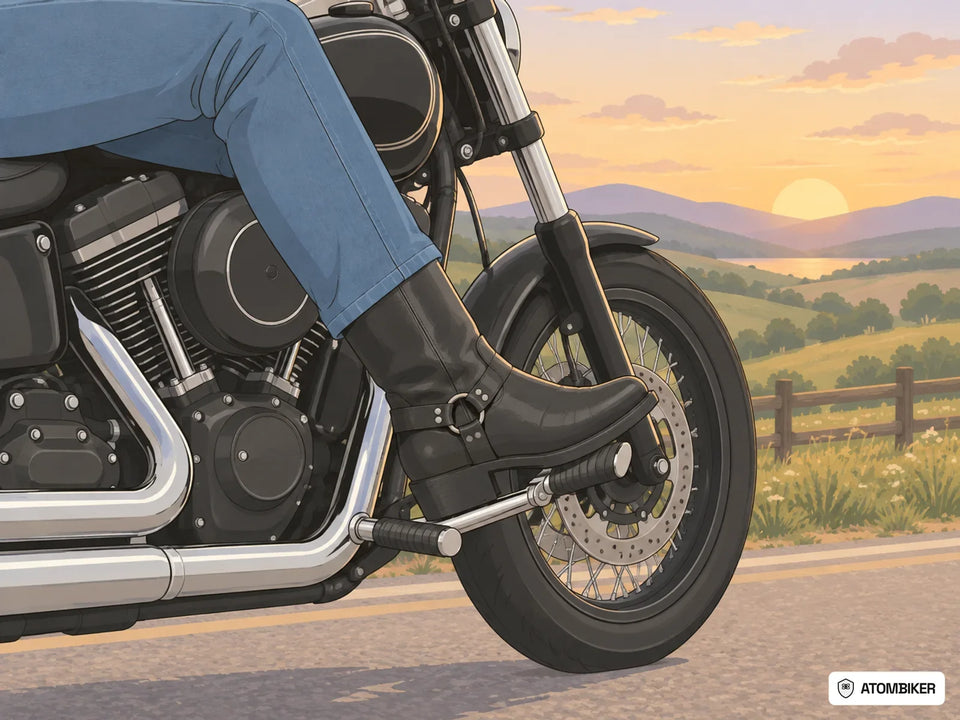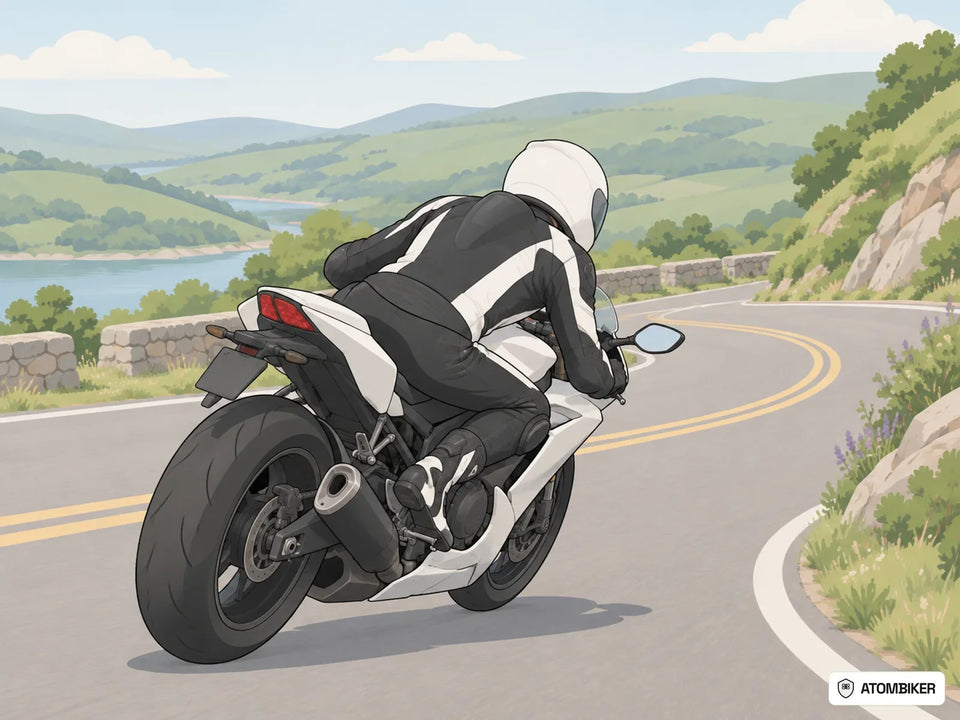

A sport motorcycle jacket in a race fit is cut for your riding tuck rather than for standing: its sleeves are pre-curved, stretch panels let your back and arms reach forward, and some add a speed hump behind the helmet. Makers such as Alpinestars judge that fit in the crouch, not upright.
Alpinestars builds its Atem v5 leather jacket around a race fit with pre-curved arms, and Vanson Leathers sets the sleeves of its sportbike jacket at about 4 o'clock. Dainese put the first hump on its race suits in 1988 to cover the spine above the back protector, and wind-tunnel work later turned it into an aerodynamic part. Stretch textile and accordion leather panels let a snug jacket reach forward, while a sport-touring cut trades that tuck for rain gear and room. Standing up, a race-fit jacket feels tight and hunched, which is why it's judged on the bike.
What is a race-fit motorcycle jacket?
A race-fit motorcycle jacket is a sport jacket cut to fit closest in the tucked riding position, with the chest, arms and back shaped around a rider leaning over the tank. Alpinestars describes its Atem v5 leather jacket as a "dedicated 'Race' fit with pre-curved arms," built for sportbike and naked sportbike riders.
AGV Sport's 2025 guide to race suit cuts calls a race fit snug and form-fitting: restrictive when you stand or walk, close to the body in a tuck. A comfort fit adds room in the arms and torso for all-day street riding, and AGV notes that the roomier cut may not hold armor as tightly against the body.
That last point is the reason race fit exists. Armor works only when it's on the joint at the moment of impact, and a close, pre-shaped jacket keeps shoulder and elbow armor in place while you're folded over the bike.
Race-fit labels are brand terms, not a standard. One maker's race fit can be another maker's sport fit, so judge the cut in your own riding position.
What are pre-curved sleeves?
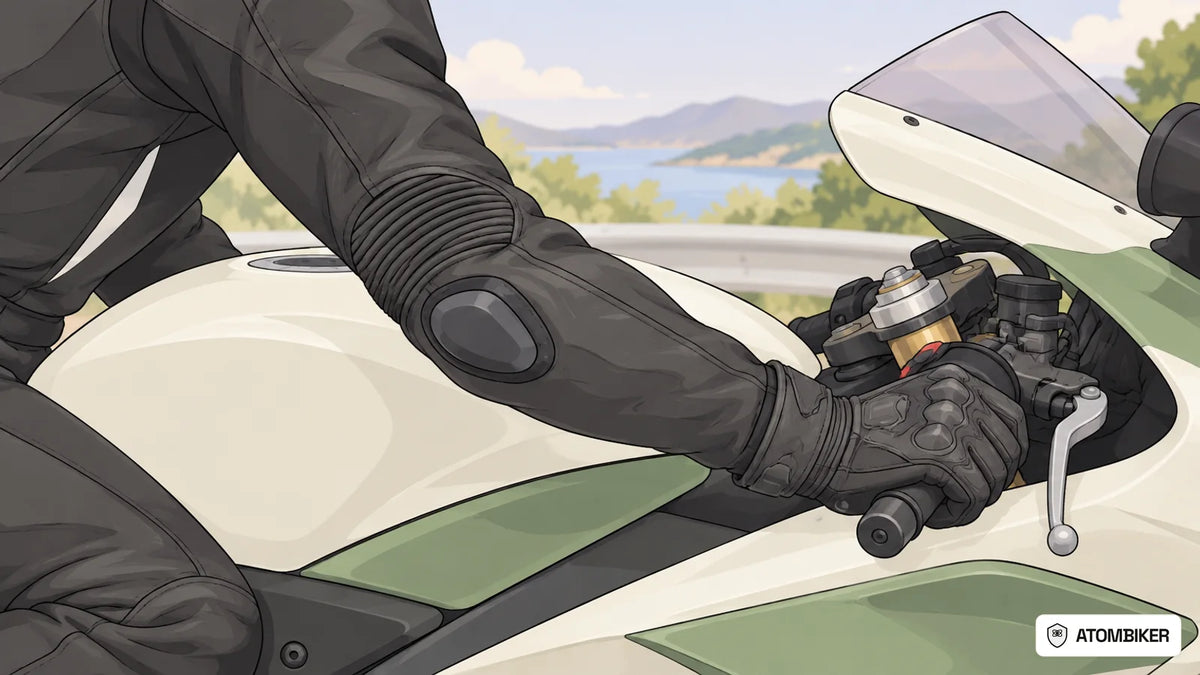
Pre-curved sleeves are jacket sleeves cut with a permanent bend at the elbow, so each arm already sits at a sportbike's reaching angle and the leather doesn't bunch at the elbow or drag at the shoulder. Alpinestars says the pre-curved elbows on its GP Force v2 jacket reduce rider fatigue on the road or track.
Vanson Leathers describes the bend in clock terms. The sleeves on its Cobra sportbike jacket hang naturally at about 4 o'clock, while its upright Sport Cruiser cut sits closer to 5 o'clock.
Stand with your arms at your sides and pre-curved sleeves pull forward and look short. Reach for imaginary clip-ons and they line up with your forearms, which is what keeps the elbow armor centered on the joint at speed.
What does a speed hump do?
A speed hump smooths the airflow between your helmet and your back when you're tucked at speed, which steadies your head and cuts drag. The speed hump, also called an aero hump, is the raised shell on the upper back of a race jacket or suit, right behind the helmet. Alpinestars lists the hump on its Atem v5 jacket "for enhanced aerodynamic performance and enhanced ventilation," and says the hump on its GP Force v2 suit is shaped with its Supertech R10 helmet to reduce drag and improve stability at high speed.
Dainese's own history of the hump, published on its Demonerosso blog in 2021, says it first appeared on Dainese suits in 1988, raced by Pierfrancesco Chili, and that it started as a safety part. The first hump was soft foam rubber covering the upper spine, an area a back protector couldn't reach without risking the neck. Racer Jean-Philippe Ruggia then found his head much steadier at high speed, with less neck-muscle fatigue, and mid-1990s wind-tunnel work stretched the hump into the longer, tapered shape used today.
Sources disagree on one point: some retailer guides call the hump crash protection for the neck, while Dainese credits it with a steadier head and less neck fatigue and makes no crash claim.
On race suits the hump also carries hardware. Dainese houses the control unit and sensors of its D-air airbag there, and some suits connect a hydration bladder through it. The aerodynamic gains makers describe come at speed in a full tuck, so a hump on a street jacket ridden upright does little for airflow.
Why do sport jackets use stretch panels?
Sport jackets use stretch panels because a tucked rider needs extra length across the back, shoulders and underarms, and leather on its own gives very little. Alpinestars' 2026 race-suit fit guide puts leather's stretch at 3-5% over the first few sessions, so a jacket cut tight enough to hold armor needs stretch built in where the body lengthens.
Accordion panels are the leather answer. They're pleated sections that open like a bellows when you reach forward, and Alpinestars places them at the lower back, shoulders and knees of its GP Force v2 suit.
Stretch textile is the lighter answer. Alpinestars' Atem v5 uses technical stretch panels under the arms, on the inner arms and around the neck, plus an A-CS Plus torso panel that the company describes as lighter and lower-profile than a traditional leather accordion panel.
Both kinds sit where your body stretches in a tuck. Look for them across the upper back, behind the shoulders and inside the elbows when you compare sport jackets.
How do race-fit and sport-touring cuts compare?
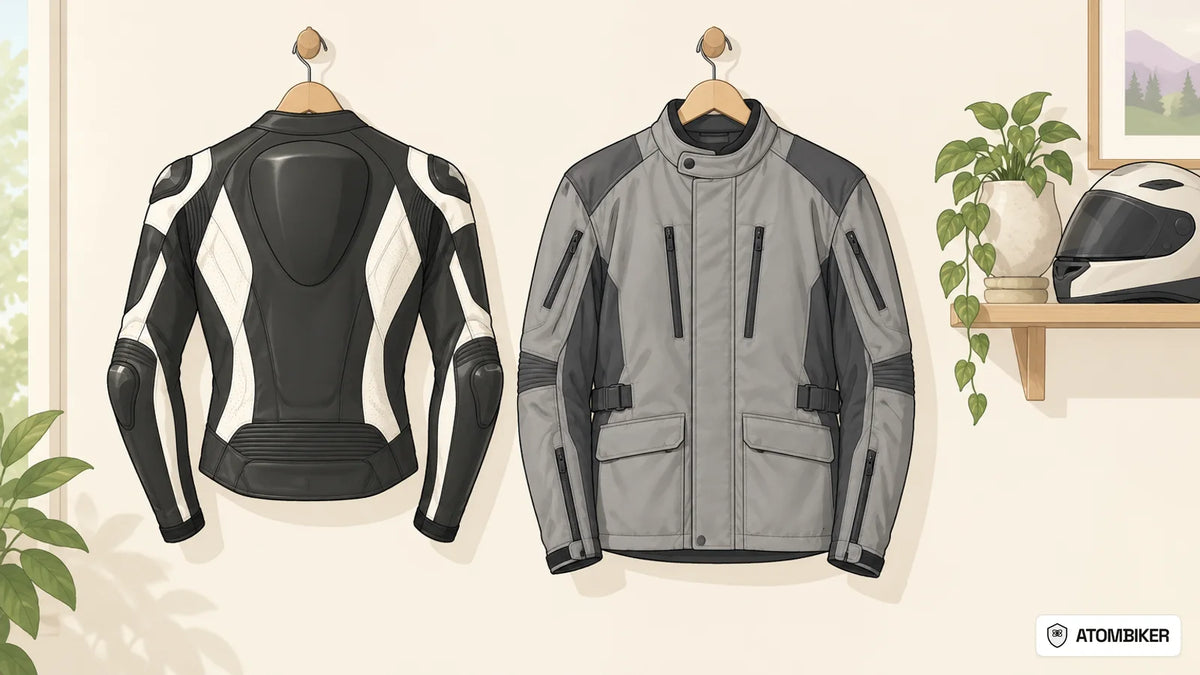
Race-fit and sport-touring cuts differ in how far forward they expect you to lean, and that one choice sets the sleeve angle, body length, stretch, weather gear and off-bike comfort. The table compares race-fit leather jackets from Alpinestars with textile road jackets from Dainese and REV'IT, using what each maker lists.
| Feature | Race-fit sport jacket | Sport-touring textile jacket |
|---|---|---|
| Riding position | Full forward tuck, hands low on clip-ons | Slight forward lean, hands at mid-height bars |
| Sleeves | Pre-curved for a long reach | Shorter reach, with wrist and bicep adjusters on the Dainese Super Rider 2 Absoluteshell |
| Body and stretch | Snug, with stretch textile or accordion leather panels (Alpinestars Atem v5) | Slim to regular, with waist and hip adjusters |
| Speed hump | On some models, such as the Atem v5 | Not listed on the Super Rider 2 or the REV'IT Potential GTX |
| Shell | Bovine leather on the Atem v5 and GP Force v2 | Textile |
| Weather layers | No waterproof layer listed on the Alpinestars examples; the GP Force v2 adds side vents and a thermal vest | Removable waterproof membrane (Super Rider 2) or GORE-TEX Z-liner plus thermal liner (Potential GTX) |
| Pants connection | 3/4 waist zip to Alpinestars pants on the Atem v5 | Jacket-to-pants zip on the Super Rider 2; short connection zip on the Potential GTX |
| EN 17092 class on the examples | AA (Atem v5, GP Force v2) | A (Super Rider 2), AA (Potential GTX) |
| Off the bike | Tight and hunched standing | Easy to stand and walk in |
EN 17092 is the European standard for motorcycle protective garments, with classes AAA, AA, A, B and C. Sport-touring riders give up some tuck comfort for rain gear and all-day room. Race-fit riders give up weather protection for a jacket that stays put at speed.
How should a race-fit jacket feel off the bike?
A race-fit jacket should feel tight across the back, short in the sleeves and slightly hunched when you stand, and that's normal as long as nothing goes numb and the armor lands on your joints once you tuck. AGV Sport says a race fit may feel restrictive when standing or walking, and Alpinestars' April 2026 fit guide for race suits sizes for the crouch, not for standing upright.
Judge it in your riding position, not in a mirror. Alpinestars names two warning signs in that guide: numbness or tingling in your hands after about 5 minutes, and armor that shifts more than 1 in (2.5 cm) when you move into the riding position. Either sign points to the wrong size or cut.
Don't buy a size down hoping the leather loosens up, since it gives only a few percent. The seated checks that apply to every jacket are in our guide on how tight a motorcycle jacket should be.
Do you need a jacket-to-pants zip for track days?
No, not at every track day, because each organizer writes its own gear rules, but plan on needing one. Rider Magazine's 2016 first-track-day guide says a two-piece suit should have a full-circumference zipper around the waist, while 2Fast Track Days, a Pacific Northwest organizer, only prefers a zipped-together suit and accepts textile suits. A 3/4 waist zip like the Atem v5's may not meet a full-circumference rule, so check the organizer's page and match the jacket to pants from the same range, as our guide to motorcycle pants types explains.
Is a race-fit jacket good for commuting?
No, not on an upright bike, because a race-fit jacket's curved sleeves and short front pull and bunch when you sit tall. On a sportbike or naked-bike commute it works, but few sport jackets are waterproof, so a Seattle commuter still needs a rain layer. Upright commuters do better with a touring cut from our guide to motorcycle jacket types.
Where can you see a Hybrid Racer leather jacket?
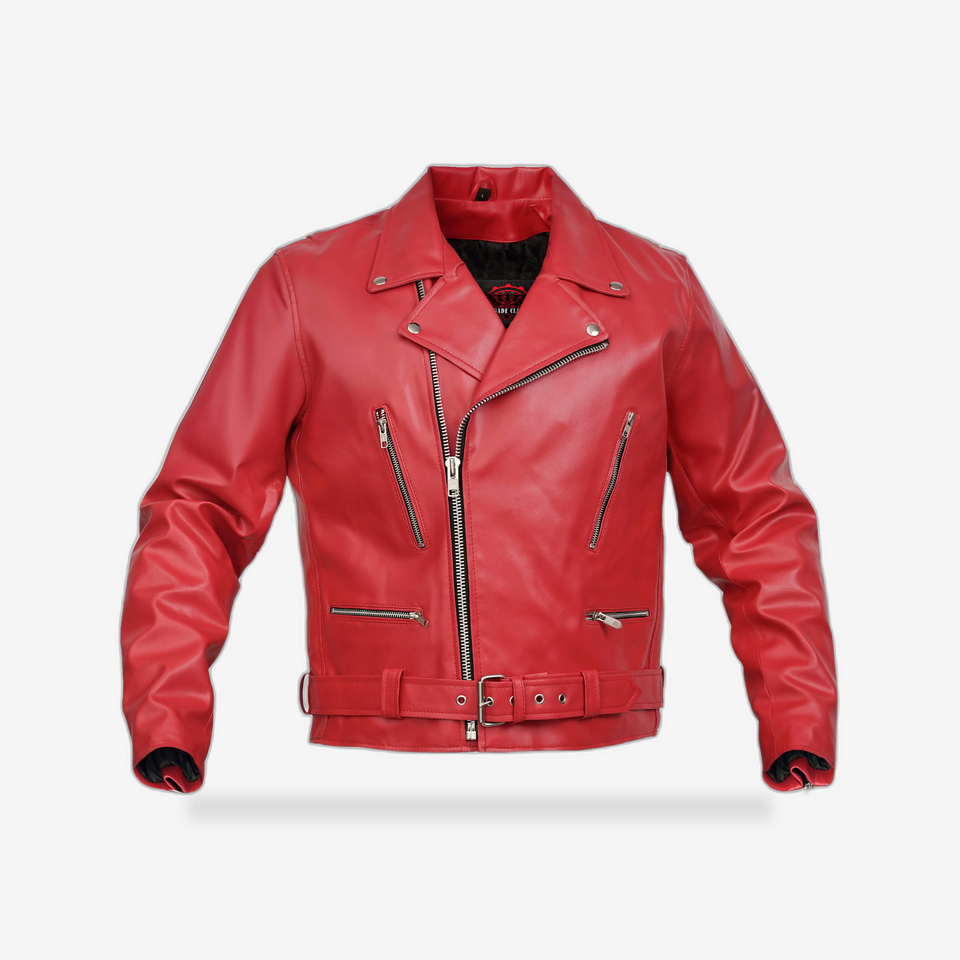
AtomBiker, a US online store for motorcycle helmets, jackets, gloves, boots and pants, sells the Hybrid Racer leather jacket, a distressed-leather jacket with a snap-tab mandarin collar, quilted elbow reinforcement and dual zip hand pockets, built for café racer and vintage sport riding. Its product page doesn't list pre-curved sleeves, a speed hump, stretch panels, a pants zip or armor, so treat it as a sport-styled street jacket and check its armor pockets before you ride.
Frequently asked questions
What is the difference between race fit and sport fit?
Race fit is the tighter cut, shaped for a full tuck, while sport fit leaves more room for a slightly higher riding position and longer days. Alpinestars uses both labels: its Atem v5 jacket is a "Race" fit with pre-curved arms, and its GP Force v2 jacket is a "Sport Fit" the company describes as a very comfortable fit. Try each one in your own riding position.
Why are race-fit jacket sleeves short?
Race-fit jacket sleeves run short at the wrist so a gauntlet glove's cuff closes over the sleeve end, according to AGV Sport. Check the length with your arms reaching for the bars, where the sleeve should still meet the glove.
Can you wear a back protector in a race-fit jacket?
Yes, race-fit jackets such as the Alpinestars Atem v5 have an inner pocket for a back protector, and the Atem v5 also takes a split chest protector. Fit the protector before you judge the size, because AtomBiker's Sizing Guide says to size up if you'll add a back protector.
Are race-fit jackets airbag compatible?
Yes, some race-fit jackets are airbag ready, and the product page names the system they take. Alpinestars lists its Atem v5 as Tech-Air 5 and Tech-Air 3 ready, and builds accordion stretch inserts into its GP Force v2 jacket that expand to make room for an airbag.
Can you wear a race-fit jacket on a naked bike?
Yes, a race-fit jacket works on a naked bike, and Alpinestars builds its Atem v5 for sportbike and naked sportbike riders. A naked bike's higher, wider bar puts your arms at a shallower angle than clip-ons, so try the sleeves in that position first.
Does a sport jacket need an EN 17092 class?
No, a sport jacket doesn't need an EN 17092 class to be sold in the US, but the class is the best proof that the whole garment passed abrasion and impact tests. Both Alpinestars examples here carry an AA class. The hide and seams matter too, as our guide to riding leather vs fashion leather explains.
Shop this guide
Start with the right questions.
Compare construction, fit and features. Open each product for its available sizes, current price and stated certifications.