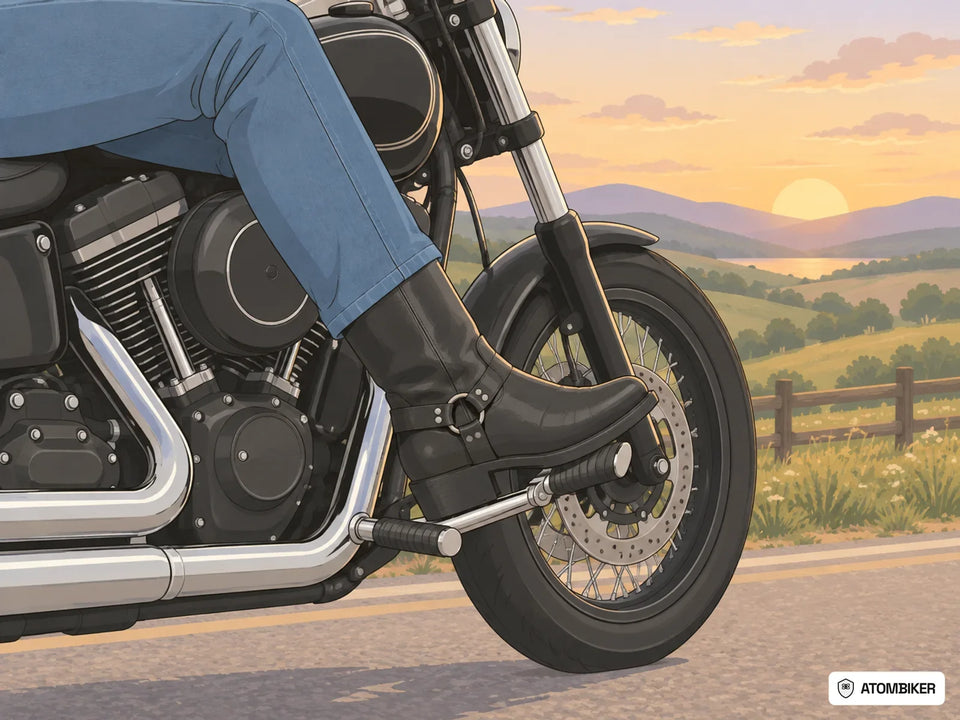

Cruiser motorcycle boots are leather riding boots built around a cruiser's low seat and foot controls, and the right pair has a low, wide heel that hooks the footpeg, a shift pad over the left toe, a firm slip-resistant rubber sole for stops, and a shaft that covers your ankles at minimum.
The Motorcycle Safety Foundation's operator manual asks for short heels and hard, slip-resistant soles, and Harley-Davidson's own riding harness boots use a 1.5 in (3.8 cm) heel. Harley-Davidson's standard forward controls sit 7.5 in (19 cm) ahead of the mid-control position, so your toe reaches out to the shift lever and wears the top of the left boot. Heavy bikes reward an oil-and slip-resistant rubber outsole at every stop, and ankle and heel reinforcements hidden in the leather keep a classic boot protective.
What makes a boot right for cruiser riding?
A boot is right for cruiser riding when it suits the bike's control layout and weight: a heel that holds the footpeg or floorboard, a toe that works the shift lever, a sole that grips at stops and a shaft that covers your ankles. The leather look comes second to those four jobs.
Cruisers place the foot controls in one of three ways. Mid controls put the pegs, shift lever and brake pedal under the seat with your knees bent at roughly 90 degrees, as SlashGear describes them (2026). Forward controls move all three ahead so your legs stretch out, and Harley-Davidson's standard forward control kit sits 7.5 in (19 cm) ahead of the mid-control position. Some floorboard bikes add a heel-toe shifter, a second lever behind your foot that you tap down with your heel to upshift.
The Motorcycle Safety Foundation (MSF) sets the baseline in its Motorcycle Operator Manual (18th edition): boots high and sturdy enough to cover and support your ankles, soles of hard, durable, slip-resistant material, short heels and tucked-in laces. Each classic cruiser style (harness boots, engineer boots, lace-up boots or side-zip boots) meets that baseline only when it's built for riding.
What heel height works on a cruiser?
A low, wide heel works on a cruiser, and 1.5 in (3.8 cm) is the height Harley-Davidson uses on its Hustin and Rory riding harness boots. Cycle World's boot guide (2016) puts the rule in one line: street riding heels should be wide and low, with enough height to hook over the footpegs.
The heel does different work on each control layout. On mid and forward controls, the heel catches behind the peg and keeps your foot from sliding forward when you brake or the road gets rough. On floorboards, the heel rests on the board and presses the heel shifter on every upshift, so the boot heel takes wear there too.
Taller isn't better. The MSF manual says to keep heels short so they don't catch on rough surfaces, which rules out tall, narrow fashion and western heels. Riders who want more reach at a stop get it from a thicker sole, which adds height without a heel that catches.
Why do cruiser boots need a shift pad?
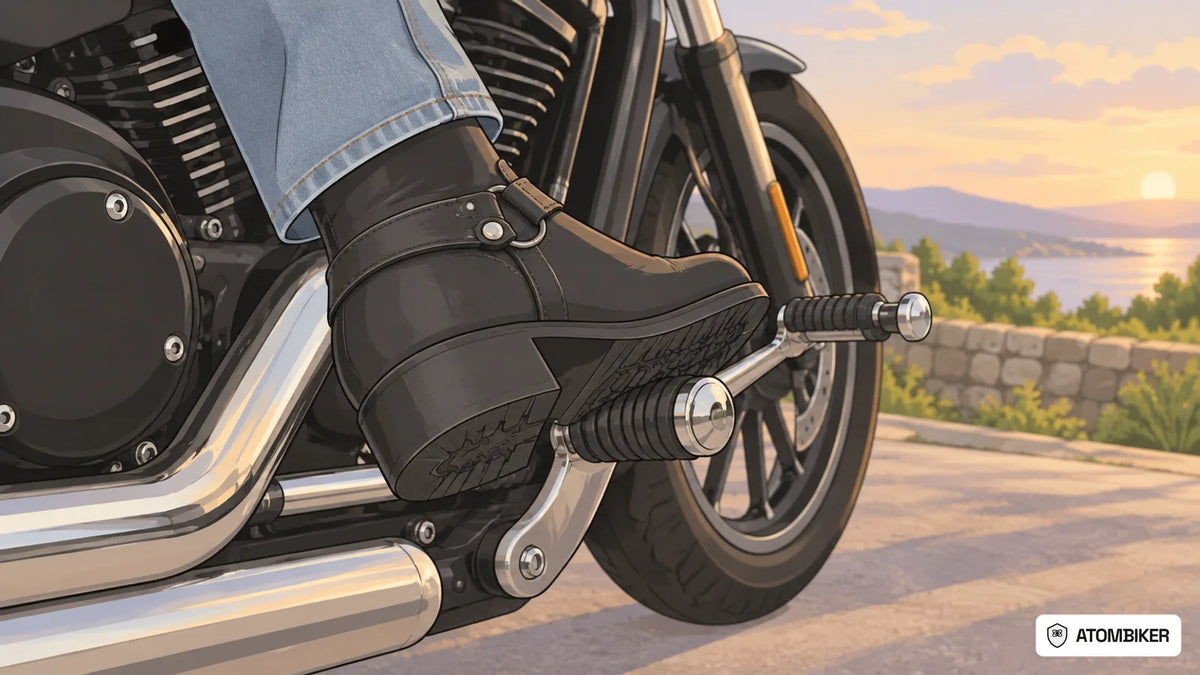
Cruiser boots need a shift pad to save the leather, not for safety: your left toe lifts the shift lever on every upshift, and a shift pad (an extra layer of leather or rubber over the top of the left toe) takes that wear instead of the upper. Cycle World says a shifter patch isn't strictly necessary but adds to boot life where the lever rubs, and Common Tread's Lemmy notes that a scuff on top of the left boot is how people spot a motorcyclist.
Classic cruiser boots show that wear clearly. Oiled and polished leather scuffs fast, and on forward controls the lever sits out ahead of you, so you hook it with the top of an outstretched foot.
The heel-toe shifter changes the picture. Common Tread notes that heel shifters exist so riders don't scuff their boots, because the upshift moves to the rear lever under your heel. Buy a shift pad when your bike has a toe-only shifter; on a floorboard bike with a heel-toe shifter it matters less, and the boot heel takes the work instead.
What sole works best for stops on a heavy cruiser?
A firm rubber outsole that resists oil and slipping works best for stops on a heavy cruiser, because your feet hold the bike up at every light, often on pavement slick with oil or fuel. The MSF manual calls for soles of hard, durable, slip-resistant material, and Cycle World adds that firm synthetic soles grip pavement well during stops and let you push down on the footpegs with less discomfort.
Look for the words "oil resistant" and "slip resistant" on the product page or label. Harley-Davidson lists an oil-and slip-resistant outsole on its Rory harness boot. EN 13634:2017, the European standard for motorcycle footwear, treats outsole slip resistance and fuel oil resistance as optional tests, so a certified boot makes those claims only when its maker chose to test them, according to SATRA Technology, a UK footwear testing organization.
Skip smooth leather soles. They slide on wet paint lines and spilled fuel, which is exactly where a heavy bike at a stop needs a planted foot.
How do cruiser boot features compare?
Cruiser boot features split into control features (heel, outsole and shift pad) and protection features (shaft height, closure and ankle protection), and a good cruiser boot gets both groups right.
The table compares each cruiser boot feature by what to look for, why it matters on a cruiser and what to avoid.
| Feature | What to look for | Why it matters on a cruiser | What to avoid |
|---|---|---|---|
| Heel | Low and wide, about 1.5 in (3.8 cm) | Hooks the footpeg and works a heel shifter | Tall, narrow heels that catch |
| Outsole | Firm rubber, oil and slip resistant | Holds a heavy bike up at stops and fuel pumps | Smooth leather soles |
| Shift pad | Extra leather or rubber over the left toe | Takes the wear from a toe shifter | Bare polished leather on a toe-only shifter |
| Shaft height | Over the ankle at minimum | Covers the ankle bones and keeps jeans from riding up | Below-the-ankle shoes |
| Closure | Side zip, buckles or straps | Nothing loose to catch on pegs or levers | Long, untucked laces |
| Ankle protection | Hidden ankle cups or reinforcements | Covers the ankle bones when a foot goes down | Plain leather with nothing inside |
How do you keep a classic look without losing protection?
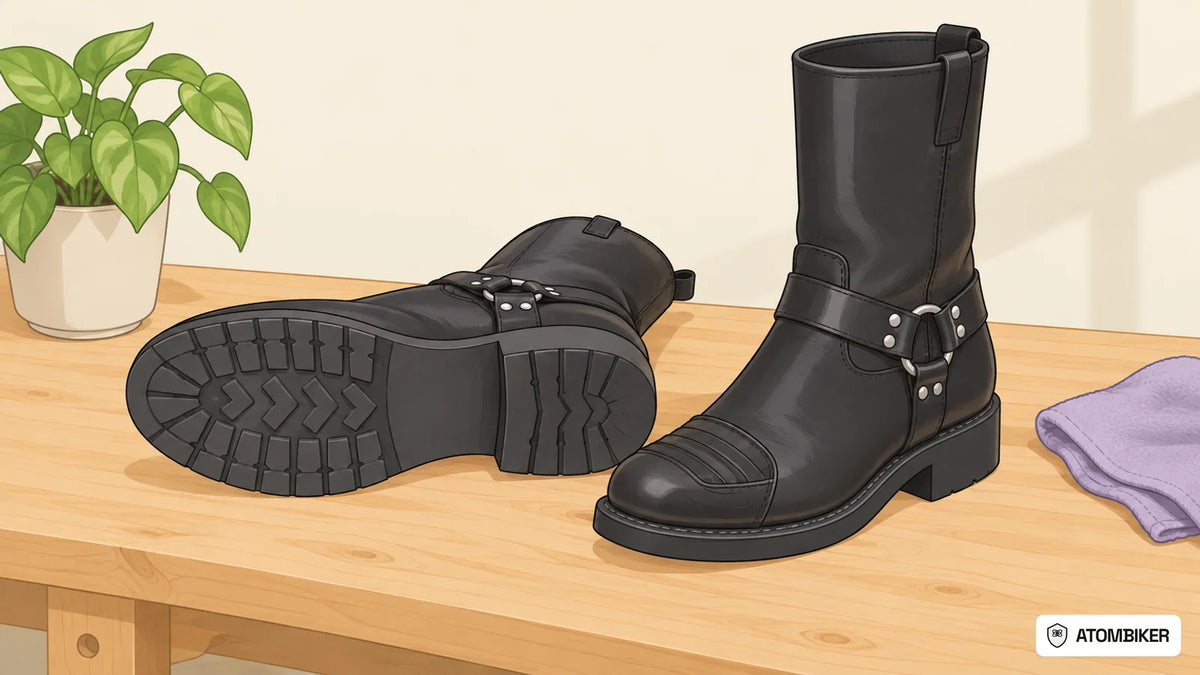
Keep the classic look by choosing protection that hides inside the leather: ankle reinforcements, a stiff heel counter, a reinforced toe and a leather shift pad under a traditional upper. TCX's vintage-styled Hero 2 WP, for example, lists toe, heel counter and ankle reinforcements plus a leather shift pad under a lace-and-zip upper.
Three checks separate a riding boot from a fashion boot. Press the sides of the boot at your ankle bones and feel for a firm cup. Pick a side zip, buckles or straps over long laces, which the MSF says to tuck in so they don't catch on the bike. Then read the label for EN 13634:2017, because a classic boot that names no standard has no tested protection to point to, and the four-number code is explained in our guide to motorcycle boot types.
No boot prevents every injury. A classic boot with hidden reinforcements still protects less than a tall race or adventure boot with a shin plate.
Are cruiser boots good for walking?
Yes, cruiser boots are among the easiest riding boots to walk in, and the trade-off is less ankle and shin support than a race or adventure boot gives. New oiled leather needs a few short wears before a day on foot, and our motorcycle boot fit guide shows how to tell break-in stiffness from the wrong size.
How tall should cruiser boots be?
Cruiser boots should be tall enough to cover your ankle bones at minimum, the MSF baseline, and a taller shaft adds shin coverage. Common classic heights include 6 in (15 cm) ankle boots, 11 in (28 cm) harness boots such as Harley-Davidson's Hustin and 13 in (33 cm) harness boots and engineer boots, and a taller shaft keeps a jeans hem from riding up over your ankle when your legs stretch out to forward controls.
Where can you see leather cruiser boots?
AtomBiker, a US online store for motorcycle helmets, jackets, gloves, boots and pants, sells the Blacktread leather harness boots, a 13-inch harness boot in full-grain oiled leather with a square toe, an oil-resistant outsole and O-ring ankle straps. Its product page lists no shift pad, ankle armor or EN 13634 rating, so judge it on the heel, sole and shift pad points before you buy.
Frequently asked questions
What boots do Harley riders wear?
Harley riders wear the classic cruiser styles: harness boots, engineer boots, lace-up boots and side-zip boots. Harley-Davidson's own line includes the Hustin and Rory harness boots, the 8-inch Riddick lace-up and the twin-zip Brake Light boot. Pick any of them on heel, sole and ankle coverage, not the logo.
Are engineer boots or harness boots better for a cruiser?
Engineer boots ride slightly better, because their buckled straps tighten the fit at the instep and the top of the shaft, while a harness boot's ring and straps are fixed. The full side-by-side is in our guide to engineer vs harness boots.
Are cruiser boots waterproof?
No, a leather cruiser boot isn't waterproof unless the maker lists it as waterproof, as Harley-Davidson does for its Hustin harness boot. Membranes and treated leather are compared in our guide to waterproof motorcycle boots.
Are lace-up boots OK on a cruiser?
Yes, lace-up boots work on a cruiser when the laces are tucked in or covered, which is the MSF's rule, because a loose lace catches on pegs and levers. A side zip next to the laces makes them quicker to pull on.
How do you look after leather cruiser boots?
Clean off road grime, let the boots dry away from direct heat and condition the leather so it stays supple, especially after rain or winter salt. The full routine is in our leather motorcycle gear care guide.
Shop this guide
Start with the right questions.
Compare construction, fit and features. Open each product for its available sizes, current price and stated certifications.


Motorcycle Boots